

Geriatric care is a specialised approach to managing the health and rehabilitation needs of older adults, typically those aged 65 and above, whose conditions are too complex or interconnected to be addressed effectively by a single clinician or a general-practice model alone.
In Singapore, where the population aged 65 and above is projected to make up nearly one in four residents by 2030, the demand for high-quality geriatric care has never been greater. Whether you are caring for an elderly parent, recovering from a fall or surgical procedure, or navigating the challenges of managing multiple chronic conditions in later life, this guide explains what geriatric care involves, when it becomes necessary, and how PhysioVitae can support you or your loved one.
What Is Geriatric Medicine?
Geriatric medicine also referred to as geriatrics is the branch of healthcare concerned with the prevention, diagnosis, and treatment of conditions that disproportionately affect older adults. These include frailty, falls, delirium, dementia, osteoporosis, incontinence, polypharmacy complications, and age-related decline in strength and mobility.
What distinguishes geriatric care from general medicine is not simply the age of the patient, but the complexity of the clinical picture. Older adults frequently present with multiple conditions simultaneously, take five or more medications (a situation known as polypharmacy), and experience accelerated deconditioning following any period of illness or inactivity. A geriatric care framework accounts for all of these dimensions at once.
At PhysioVitae, our Geriatric (Elderly) Rehabilitation programme is built around this same principle: treating the whole person, not just the presenting complaint.
What Does a Geriatric Specialist Do?
A geriatric care specialist whether a physician, physiotherapist, or allied health professional with geriatric training focuses on maintaining and restoring the older adult’s ability to function independently and safely in daily life. Their role spans assessment, rehabilitation, and long-term management.
In a physiotherapy context, geriatric-focused care typically involves:
- Comprehensive functional and physical assessment to establish a baseline
- Falls risk evaluation and falls prevention programmes
- Targeted exercise prescription to rebuild strength, balance, and cardiovascular fitness
- Gait and mobility rehabilitation, including use of assistive devices
- Post-hospitalisation or post-surgical recovery programmes
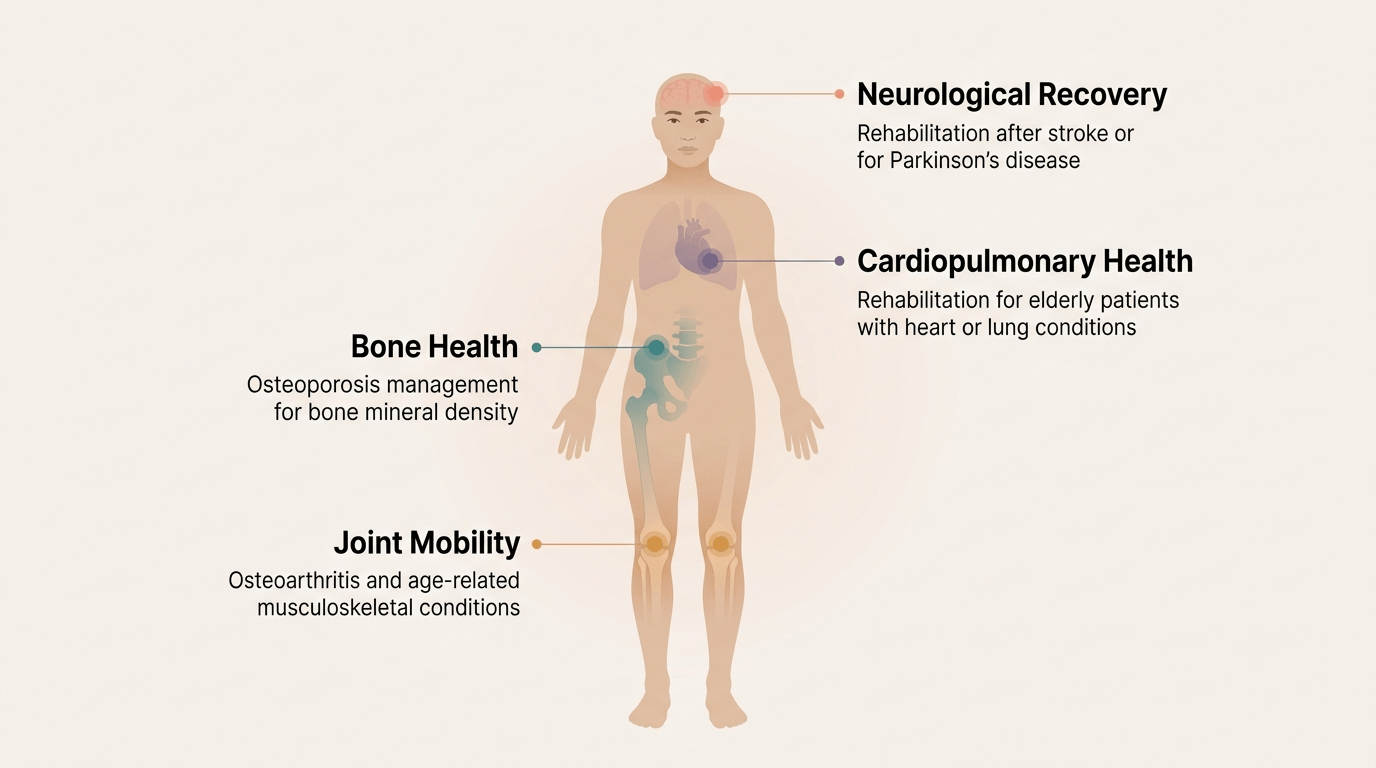
- Management of osteoporosis, osteoarthritis, and other age-related musculoskeletal conditions
- Home therapy for patients with limited mobility or those who cannot safely travel to a clinic
At PhysioVitae, our physiotherapists with geriatric specialisation apply structured functional testing, including the Timed Up and Go (TUG) test, the Berg Balance Scale, and the Short Physical Performance Battery (SPPB), to objectively measure fall risk and functional capacity at the outset of care. These tools allow us to set measurable, meaningful goals and track progress with precision.
What Is a Comprehensive Geriatric Assessment (CGA)?
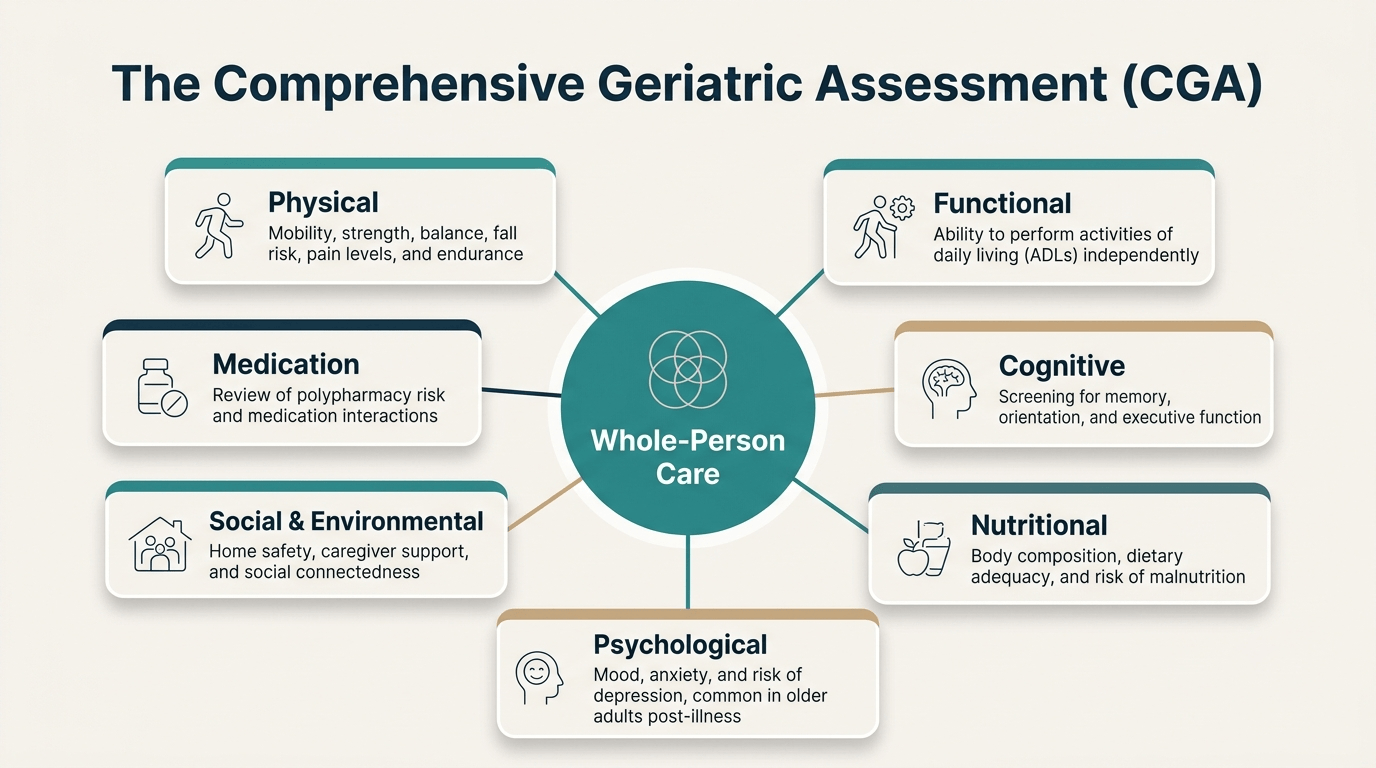
The Comprehensive Geriatric Assessment (CGA) is the gold-standard evaluation framework in geriatric medicine. Rather than focusing on a single symptom or diagnosis, the CGA systematically evaluates every domain of an older adult’s health physical, functional, cognitive, nutritional, psychological, social, and environmental.
The goal of the CGA is not simply to diagnose problems, but to produce an integrated care plan that addresses them all in a coordinated way. Research consistently shows that patients managed through a CGA-informed approach experience better functional outcomes, reduced hospital readmission, and improved quality of life compared to those receiving standard care.
| Domain | What Is Assessed |
| Physical | Mobility, strength, balance, fall risk, pain levels, and endurance |
| Functional | Ability to perform activities of daily living (ADLs) independently |
| Cognitive | Screening for memory, orientation, and executive function |
| Nutritional | Body composition, dietary adequacy, and risk of malnutrition |
| Psychological | Mood, anxiety, and risk of depression, common in older adults post-illness |
| Social & Environmental | Home safety, caregiver support, and social connectedness |
| Medication | Review of polypharmacy risk and medication interactions |
In our experience assessing elderly patients referred post-hospitalisation, the most commonly missed domain is psychological wellbeing. Older adults who have experienced a significant health event often present with subclinical depression or anxiety that substantially affects their engagement with rehabilitation, and their recovery trajectory. A geriatric framework catches this where a standard musculoskeletal assessment would not.
Read More: How Much Does Physiotherapy Cost in Singapore? (2026 Guide)
Signs Your Elderly Loved One May Need Geriatric Care
Geriatric care becomes particularly important when general medical care no longer feels adequate when your loved one is seeing multiple specialists but no one seems to be looking at the full picture, or when functional decline is progressing despite treatment.
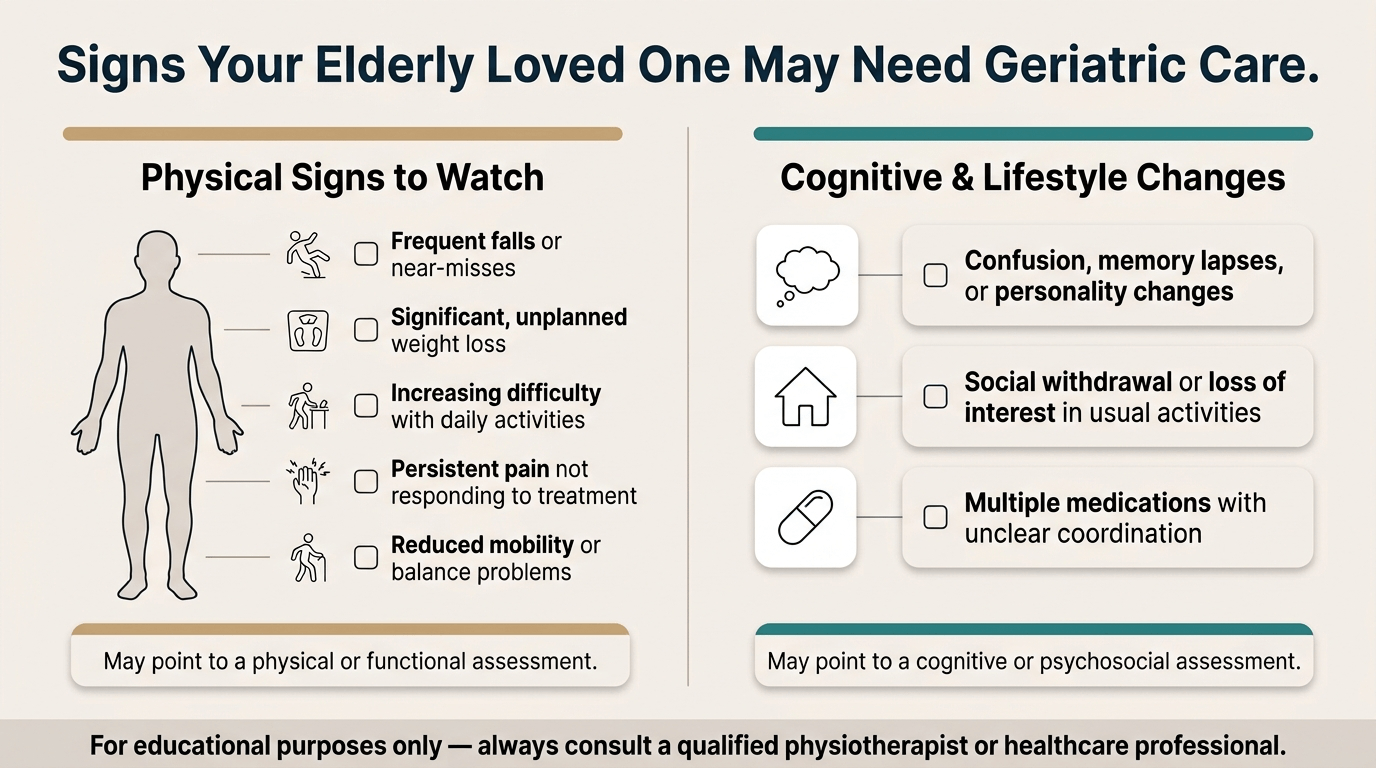
Watch for the following signs that a more structured geriatric approach may be needed:
| Physical Signs to Watch | Cognitive & Lifestyle Changes |
| Frequent falls or near-misses | Confusion, memory lapses, or personality changes |
| Significant, unplanned weight loss | Social withdrawal or loss of interest in usual activities |
| Increasing difficulty with daily activities | Multiple medications with unclear coordination |
| Persistent pain not responding to treatment | |
| Reduced mobility or balance problems |
If several of these signs are present together, a comprehensive geriatric assessment is likely to provide the clearest path forward. Early intervention consistently produces better outcomes than waiting until a crisis such as a serious fall or hospitalisation, forces the issue.
Read More: Left Chest Pain: Common Causes, Warning Signs & When Physio Can Help
Refer a Patient or Enquire About Geriatric Rehabilitation
If you are concerned about an elderly parent, spouse, or family member, whether they are recovering from a fall, a hospitalisation, or simply experiencing a gradual decline in mobility and independence, a clinical assessment is the clearest and most useful next step. You do not need to have a diagnosis in hand to get started.
To learn more about the full range of conditions we manage, visit our physiotherapy and rehabilitation services page. For practical guidance on what to expect from physiotherapy in Singapore, explore the PhysioVitae patient education library.
When you are ready to make an appointment or speak with a member of our team, contact us here. We are available Monday to Friday, 9am–6pm, and Saturday, 9am–1pm, at 360 Orchard Road, #12-06 International Building, Singapore 238869.
Frequently Asked Questions About Geriatric Care
At what age is someone considered to need geriatric care?
There is no strict age threshold. Geriatric care becomes appropriate when ageing-related complexity, such as frailty, multiple chronic conditions, cognitive decline, or functional dependency, makes a more comprehensive and coordinated approach necessary. For some individuals this happens in their late 60s; for others, not until their 80s.
Do I need a doctor’s referral to access geriatric physiotherapy at PhysioVitae?
No. In Singapore, you can access physiotherapy directly without a GP referral. Simply contact our team to book an initial consultation. If your elderly family member has complex medical conditions or has recently been discharged from hospital, we will coordinate with their doctor to ensure the rehabilitation programme is appropriate and safe.
Can PhysioVitae provide physiotherapy at my elderly parent’s home?
Yes. Our home therapy service is specifically designed for elderly patients who have difficulty travelling to the clinic due to mobility limitations, recent surgery, or medical complexity. The same comprehensive assessment and personalised treatment approach is delivered in the comfort of your home.
This article is for educational purposes and does not replace a clinical assessment. If you are concerned about an elderly family member’s health or functional ability, please consult a qualified physiotherapist or healthcare professional.
Geriatric Services Available at PhysioVitae
PhysioVitae’s geriatric rehabilitation service is delivered by AHPC-registered physiotherapists with specialist training in elderly care. All sessions are conducted either at our Orchard Road clinic (360 Orchard Road, #12-06 International Building) or through our home therapy service for patients who cannot travel safely or comfortably to the clinic.
Our Geriatric (Elderly) Rehabilitation programme covers:
- Falls prevention and balance retraining
- Post-hospitalisation and post-surgical rehabilitation
- Strength and mobility restoration for frail or deconditioned patients
- Osteoporosis management (Osteo-Vitae), evidence-based resistance and impact training to improve bone mineral density
- Neurological rehabilitation for elderly patients post-stroke or with Parkinson’s disease
- Cardiopulmonary rehabilitation for elderly patients with heart or lung conditions
- Home therapy, comprehensive assessment and treatment delivered in the patient’s own home
Sessions are typically 45 to 60 minutes. Your physiotherapist will discuss a personalised session frequency and total treatment course at your first consultation. We do not offer a one-size-fits-all programme, geriatric rehabilitation is inherently individual.