
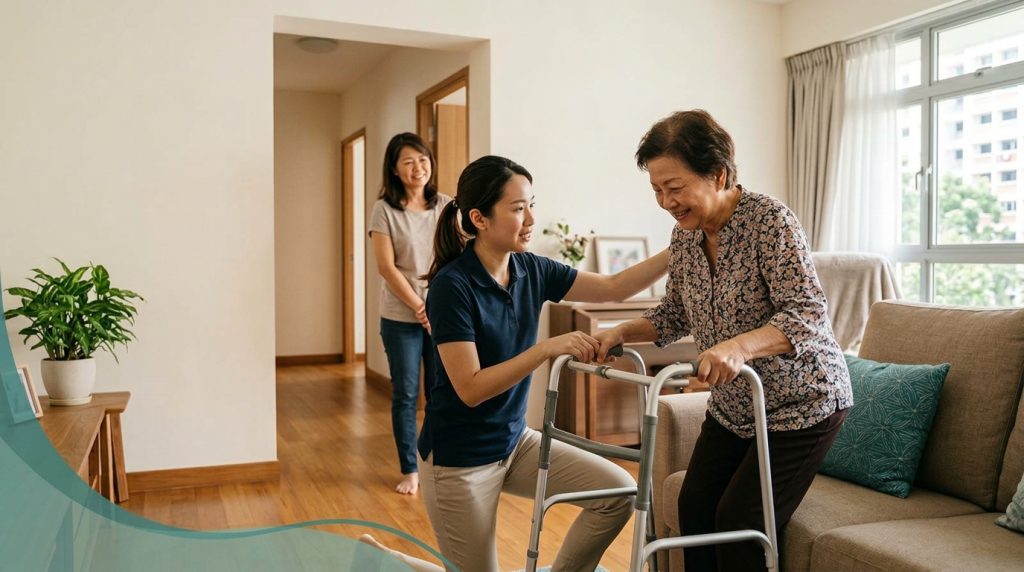
Home physiotherapy in Singapore brings a registered physiotherapist to your home to assess and treat problems with walking, strength, balance and breathing, most often after surgery, a hospital stay or a gradual loss of mobility. At PhysioVitae, sessions typically last 45 to 60 minutes and are planned around the rooms, steps and daily routines where your recovery has to work.
When to seek urgent medical care instead
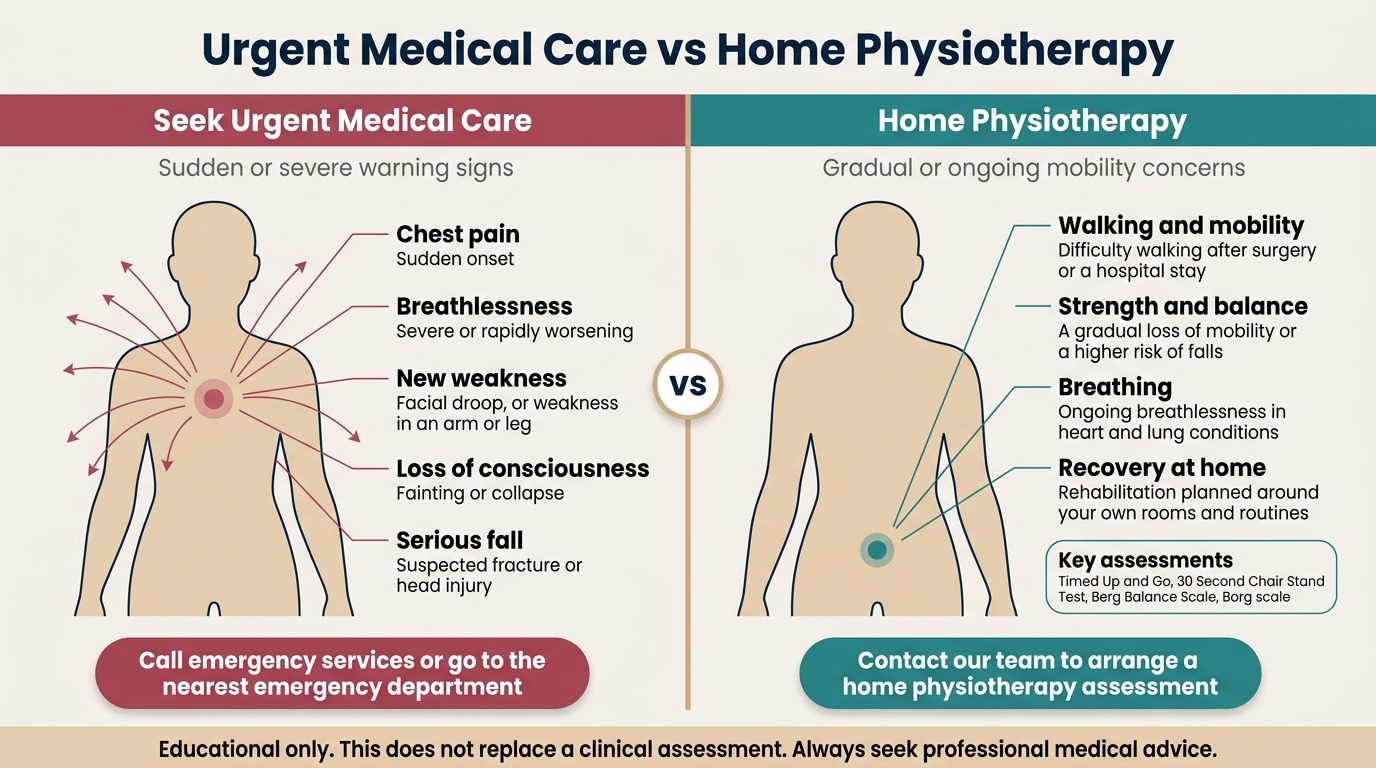
Home physiotherapy does not replace emergency care. Call 995 or go to the nearest emergency department for sudden chest pain, severe or rapidly worsening breathlessness, new facial droop or weakness in an arm or leg, loss of consciousness, or a serious fall with a suspected fracture or head injury.
What Home Physiotherapy Involves
The Agency for Integrated Care describes home therapy as a service that brings rehabilitation to frail, homebound seniors so they can regain the ability to handle everyday activities. Private physiotherapy at home follows the same principle but is open to anyone whose recovery is easier, safer or more meaningful at home, from an elderly parent after a fall to a working adult recovering from a long hospital admission.
How We Assess You at Home
Every assessment starts with the question that matters most to you and your family: what feels hard right now? Your physiotherapist then reviews your medical history, any surgical precautions and your medications before measuring what your body can currently do. Depending on your condition, we may use standardised tests such as the Timed Up and Go, the 30 Second Chair Stand Test and the Berg Balance Scale for mobility and falls risk, or a walking test paired with the Borg scale for breathlessness in heart and lung conditions. These give a baseline we can repeat, so progress is measured rather than guessed.
We also assess the home itself: the bed height, your usual chair, the bathroom step, the corridor to the lift lobby and any trip hazards.
How We Treat, and Why We Start Where We Do
Treatment uses the same methods as our clinic: individually prescribed strength and balance exercise, walking and transfer training, breathing exercises and chest physiotherapy, and manual therapy for stiff joints where it helps. Because PhysioVitae integrates lifestyle medicine into physiotherapy, the plan can also address activity levels, sleep, nutrition and stress when they are holding recovery back.
We prioritise safe transfers and the route to the toilet before longer walks or stairs, because a fall in the first weeks at home can undo a great deal of progress. Evidence supports this approach: a Cochrane review of 108 trials found that exercise programmes reduce the rate of falls among older people living in the community by approximately 23%.
In our experience, families who contact us after a hospital discharge rarely lead with questions about exercise. They ask whether their loved one can reach the toilet safely at night, or whether they can manage the step into the shower on their own. Those answers usually shape the first plan more than the diagnosis on the discharge summary does.
What to Expect From Your First Home Visit
Before the visit, we ask for any discharge summary, surgical notes or specialist instructions, along with a short description of the main difficulty. This helps us match you with a physiotherapist whose background suits the case, whether that is geriatric, cardiopulmonary, surgical or musculoskeletal rehabilitation.
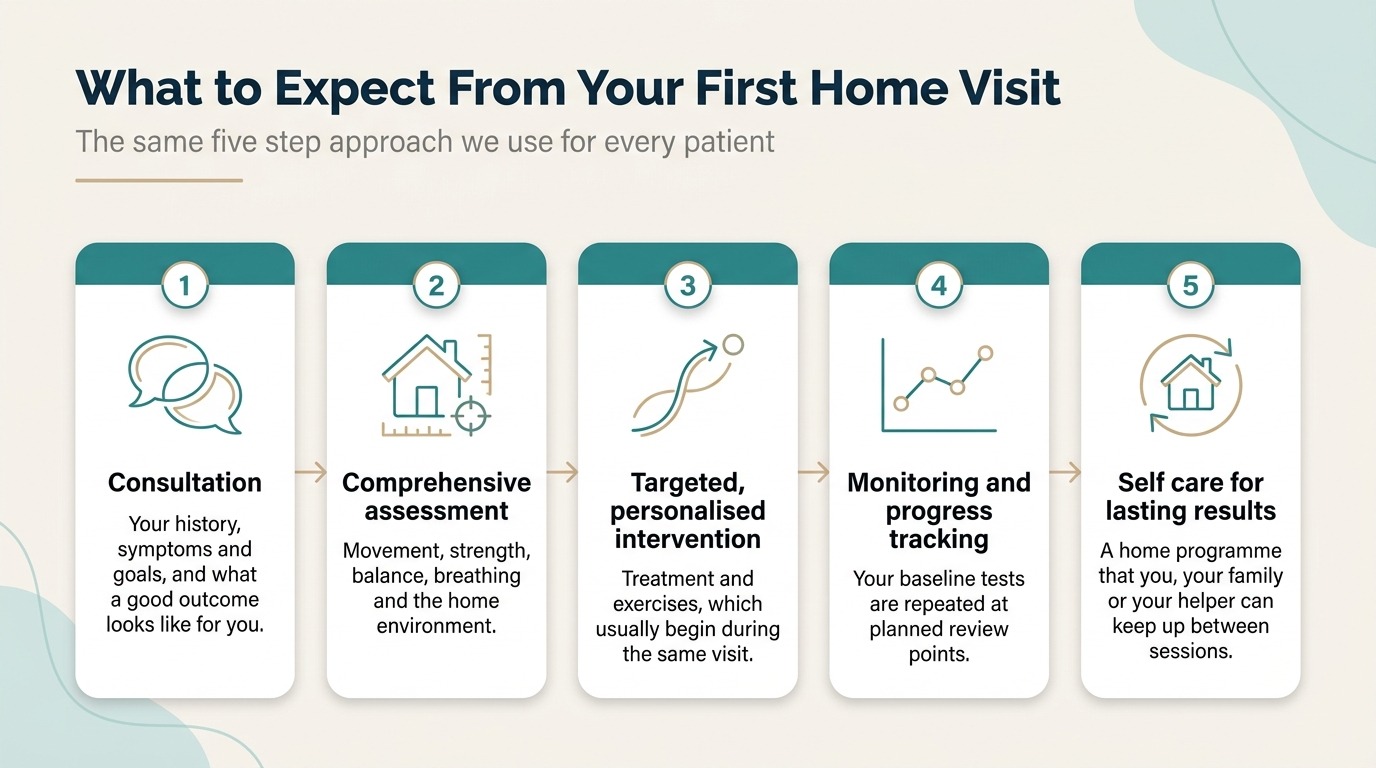
Your first session then follows the same five step approach we use for every PhysioVitae patient:
- Consultation. Your history, symptoms and goals, and what a good outcome looks like for you.
- Comprehensive assessment. Movement, strength, balance, breathing and the home environment.
- Targeted, personalised intervention. Treatment and exercises, which usually begin during the same visit.
- Monitoring and progress tracking. Your baseline tests are repeated at planned review points.
- Self care for lasting results. A home programme that you, your family or your helper can keep up between sessions.
If a family member or domestic helper assists with daily care, we show them how to support transfers and walking safely. They are usually the ones present when it matters most.
How Progress Usually Looks
Wondering how long home physiotherapy takes to work? Many patients find everyday tasks feel steadier and less tiring within the first few weeks, while strength, balance and walking endurance take longer to build. Rehabilitation after surgery or a hospital stay is commonly planned over eight to twelve weeks, with visits reduced as you become more independent. Your physiotherapist will give you a realistic estimate after the first assessment and review it as you go.
Progress is rarely a straight line. A chest infection, a change in medication or a few poor nights of sleep can mean a slower week, and the plan is adjusted to suit. As mobility improves, many patients move from home visits to sessions at our Orchard Road clinic, where more equipment is available for the later stages of rehabilitation.
Common Situations We See in Singapore Homes
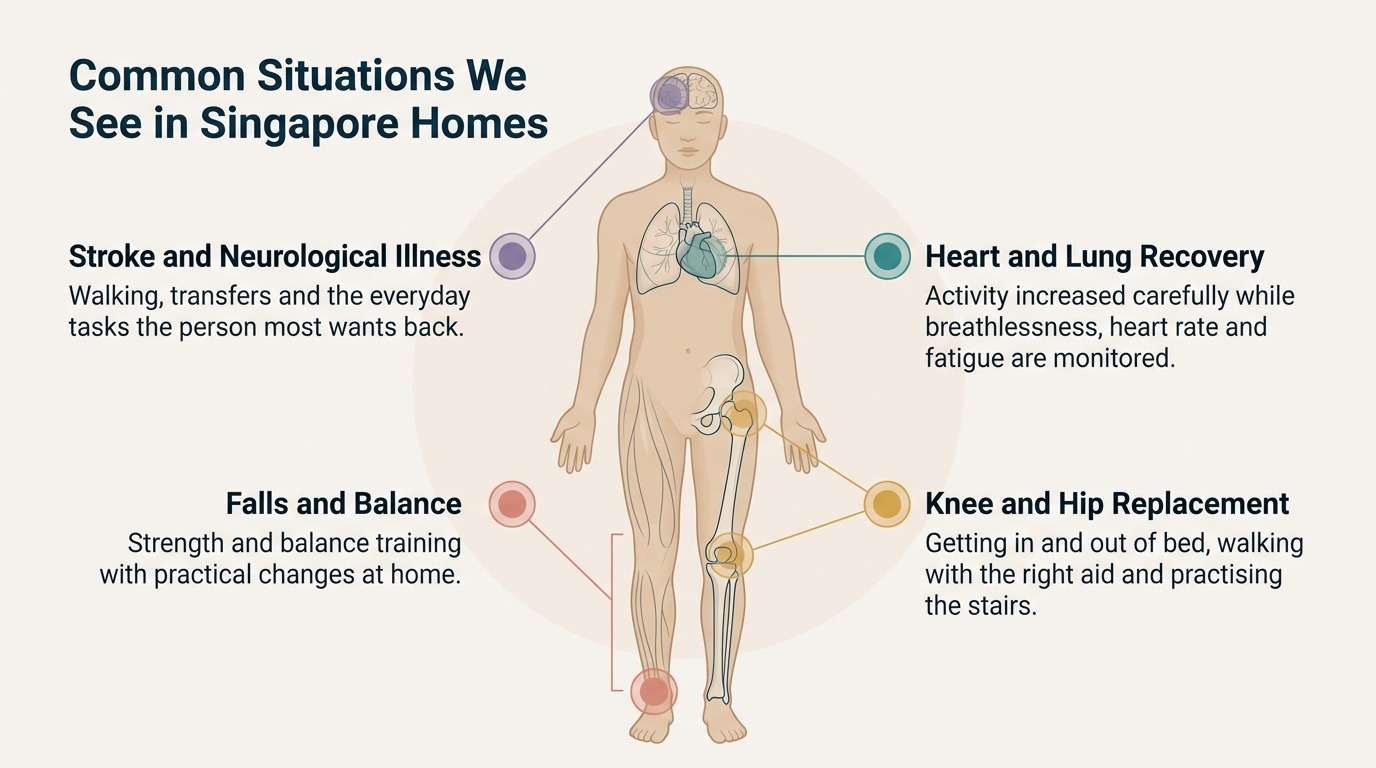
- After a knee or hip replacement. Early visits focus on getting in and out of bed, walking with the right aid and practising the stairs or the step at your front door, within the precautions your surgeon has set.
- An elderly parent who has started to fall. In many HDB flats the risks sit in familiar places: a raised bathroom threshold, a wet floor and a dim corridor at night. Strength and balance training is combined with practical changes at home and, where it would help, a fuller comprehensive geriatric assessment.
- Recovery after a hospital stay for heart or lung illness. After pneumonia, heart failure or a flare of COPD, activity is increased carefully while breathlessness, heart rate and fatigue are monitored. When patients are ready, they can continue with our cardiac rehabilitation programme or pulmonary rehabilitation programme at the clinic.
- After a stroke or other neurological illness. Sessions centre on walking, transfers and the everyday tasks the person most wants back, with family members shown how to help without taking over.
7 Things to Check Before You Book a Home Physio
Whichever provider you choose, these seven checks will help you judge whether a home physiotherapy service is built around genuine rehabilitation or simply convenience.
- Registration and experience. Every physiotherapist practising in Singapore must be registered with the Allied Health Professions Council (AHPC) and hold a valid practising certificate. All PhysioVitae physiotherapists are fully registered, and three of our principal physiotherapists previously worked at Tan Tock Seng Hospital across cardiac, respiratory, geriatric and surgical care.
- A proper assessment on the first visit. The first session should set a measurable baseline, not simply hand over a sheet of exercises.
- Experience that matches the patient. Home physio describes a location, not a specialty. Someone recovering from cardiac surgery needs a different skill set from someone rebuilding strength after a fall, so describe the main medical issues when you enquire.
- Goals you can measure. Look for specific targets, such as standing up from a chair without help, walking to the lift lobby with a stick or managing a flight of stairs, with planned points to retest them.
- Practice in the real home environment. Rehabilitation should happen on your bed, your chair, your bathroom step and your corridor, because that is where the difficulties occur.
- Coordination with your medical team. With surgical precautions, cardiac medication or a respiratory condition in the picture, your physiotherapist should know when to check with your doctor. Our programme includes coordination with doctors and healthcare partners where it is clinically appropriate.
- Clear fees and a plan for independence. Ask what the fee includes, whether it includes GST, how many visits are likely and how the plan will taper off. Good home rehabilitation should make you less dependent on therapy over time, not more.
Cost, Session Length and Insurance
Private home physiotherapy in Singapore typically costs between S$280 and S$400 per session, as set out in our guide to physiotherapy costs in Singapore. The higher fee compared with clinic sessions reflects the physiotherapist’s travel time as well as a full session of 45 to 60 minutes. We confirm the fee for your visit before you book, and no doctor’s referral is needed.
Standard outpatient physiotherapy usually falls outside MediShield Life. If your home visits are part of your recovery after an inpatient stay, an Integrated Shield Plan rider that covers rehabilitation after hospitalisation may apply, so check with your insurer before you start. Seniors who are frail and homebound may also qualify for subsidised home therapy through the Agency for Integrated Care, usually on a doctor’s recommendation.
Home Physiotherapy in Singapore: Frequently Asked Questions
What is home physiotherapy?
Home physiotherapy is assessment and treatment by a physiotherapist in your own home. It suits people who find it hard to travel because of limited mobility, a medical condition or recent surgery. Treatment is built around the spaces and tasks you manage every day.
Who can benefit from home physiotherapy in Singapore?
It often helps people who are recovering from surgery or a hospital stay, or who have difficulty walking or travelling to a clinic. Many families also arrange home physiotherapy for elderly parents who need rehabilitation at home. It suits people whose chronic condition affects their mobility or breathing, too.
What treatments are included in home physiotherapy?
Sessions may include mobility and strengthening exercises, rehabilitation after surgery or illness, breathing exercises and pulmonary rehabilitation, and balance training to prevent falls. Every programme is personalised. The aim is to help you or someone who needs rehabilitation regain independence and daily function.
Do I need a doctor’s referral for home physiotherapy in Singapore?
No. In Singapore, you can see a physiotherapist directly. If you have recently had surgery or have a complex medical condition, please share your discharge summary or specialist instructions. We may also coordinate with your doctor to keep your programme safe.
How long does a home physiotherapy session last?
Sessions typically last 45 to 60 minutes. The exact length depends on your programme and how much activity you can comfortably manage on the day.
Will my insurance cover home physiotherapy?
It depends on your policy. Some plans include rehabilitation benefits, while others need prior approval or have limits. Check with your insurer before you start, and ask our team which insurance panels PhysioVitae currently supports.
Not Sure Whether Home Physiotherapy Is Right for You?
If you are unsure whether you or a family member needs a home visit, clinic sessions or simply more rest, a short conversation with our team is a good place to start. Tell us what is happening, and we will suggest the most suitable next step, even if that is not a home visit. You can meet our physiotherapists and their hospital backgrounds, read answers to common questions about physiotherapy at PhysioVitae, or contact our Orchard Road team to arrange a home visit. WhatsApp at +65 8017 1206
Medical disclaimer: This article is for educational purposes and does not replace a clinical assessment. Seek urgent medical attention for emergency symptoms or any sudden deterioration.