
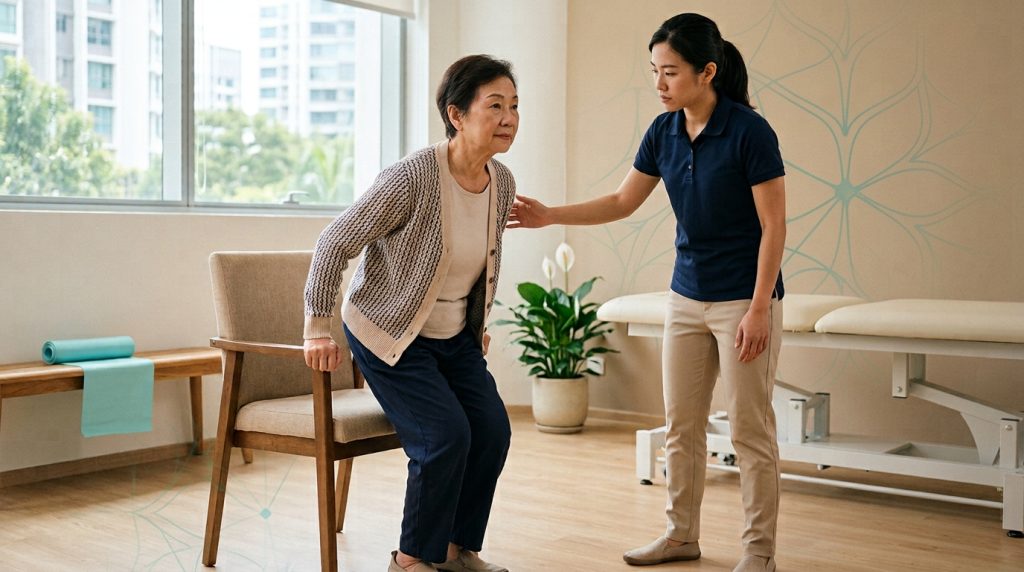
A geriatric syndrome is a health problem that becomes more common with age but does not fit neatly into a single disease category. Falls, frailty, cognitive decline, incontinence and delirium are the most frequently seen. Each usually has several causes acting together, which is why they respond best to coordinated care rather than a single treatment.
What Are Geriatric Syndromes?
Most medical conditions have a clear location and a clear mechanism. A fractured wrist is a fractured wrist. Geriatric syndromes work differently. They are patterns of difficulty that emerge when several age-related changes overlap, and the same presenting problem can have quite different underlying drivers from one person to the next.
Take a fall. In one person, it may come down to reduced leg strength and a slippery bathroom floor. In another, the same fall might trace back to blood pressure medication causing dizziness on standing, poor vision, and a pair of loose slippers. Both people fell. Neither has the same problem to solve. This is the central idea behind geriatric syndromes and the reason a single specialist rarely has the full picture.
It also explains why these conditions are so often missed or written off. Families frequently tell us they assumed slower walking, reduced appetite or occasional confusion were simply part of getting older. Some decline with age is normal. A meaningful loss of function over months, however, usually has a cause worth identifying, and quite often more than one that can be addressed.
The 5 Most Common Geriatric Syndromes
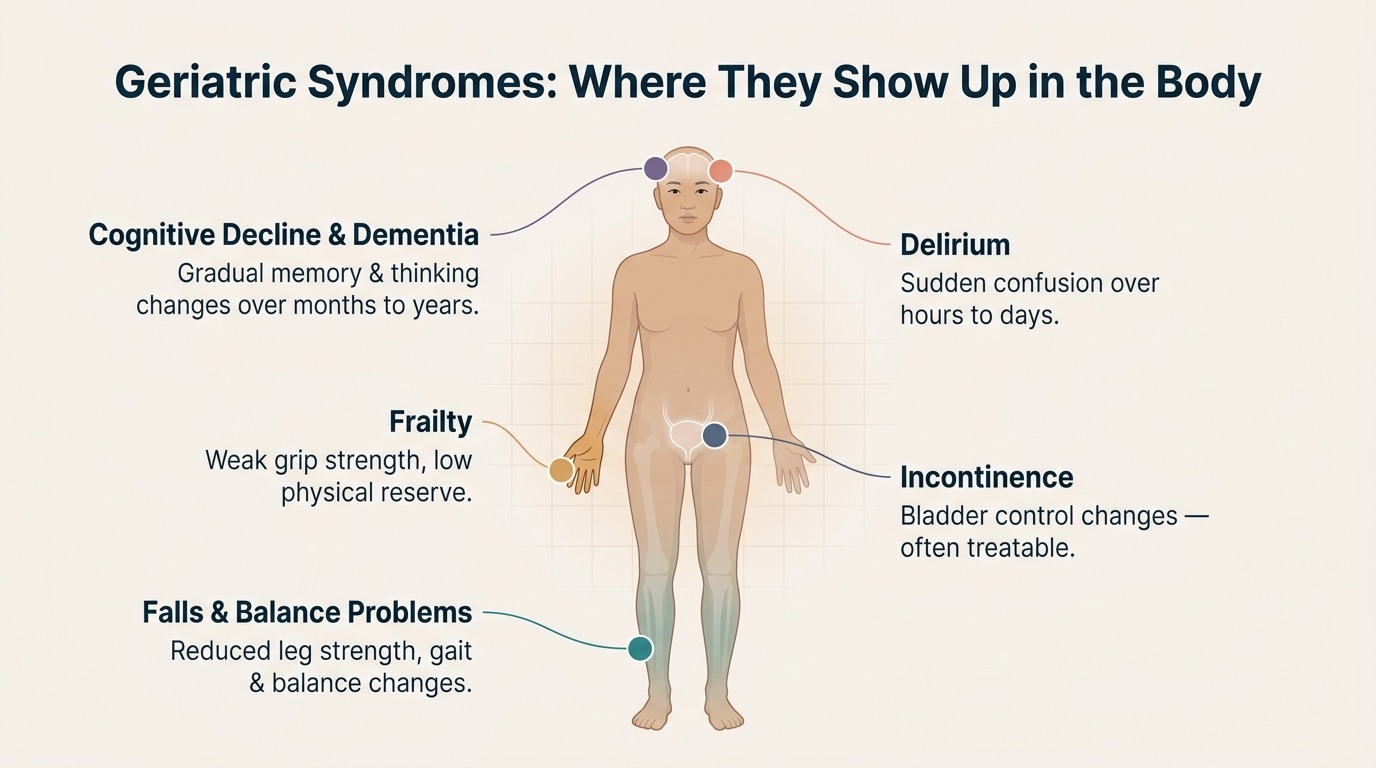
The five below account for the majority of the reasons older adults come into contact with rehabilitation and geriatric services in Singapore.
Falls and Balance Problems
Falls are the most visible of the geriatric syndromes and the one with the most immediate consequences. Widely cited international figures put the rate at roughly one in three adults aged 65 and above experiencing a fall each year, and the risk rises sharply after a first fall. In Singapore, much of this happens at home rather than outdoors, often in the bathroom or when negotiating a step, a threshold or a low kerb.
What makes falls worth taking seriously is the loss of confidence that tends to follow. Someone who has fallen once will often walk less, avoid going out alone, and gradually lose the very strength and balance that protected them. That cycle is one of the most reversible parts of the whole picture, which is why falls are usually where rehabilitation starts.
Frailty
Frailty describes a state of reduced physiological reserve, in which the body has less capacity to bounce back from illness, surgery, or even a bad week. It is not simply thinness or old age. Clinicians commonly recognize it through a cluster of features, including unintentional weight loss, self-reported exhaustion, weak grip strength, slow walking speed, and low physical activity.
Frailty sits underneath a great many other problems. A frail person who catches a chest infection is far more likely to end up in hospital, to lose mobility while there, and to struggle to return to their previous level of independence afterwards. The encouraging part is that frailty is not a one-way street. Progressive resistance exercise and adequate protein intake can measurably improve strength and walking speed even in people well into their eighties.
Cognitive Decline and Dementia
Cognitive decline covers a spectrum, from mild memory lapses that do not interfere with daily life through to dementia, where thinking and memory changes are significant enough to affect independence. Diagnosis is made by a doctor, usually a geriatrician, neurologist, or memory clinic specialist, and involves cognitive testing alongside investigations to rule out reversible causes such as thyroid problems or vitamin deficiencies.
Physical health and cognitive health are more closely linked than most families expect. Cognitive changes frequently affect walking, balance and the ability to manage two tasks at once, which is why someone with early dementia may fall more often even when their legs are relatively strong. Physiotherapy does not treat dementia itself, but keeping someone moving safely and confidently makes a real difference to how well they live with it.
Incontinence
Urinary incontinence is common, under-reported, and far more treatable than most people assume. Many older adults never raise it, either because they find it embarrassing or because they have concluded it is inevitable. It is not. Stress incontinence, where leakage occurs on coughing or lifting, and urge incontinence, where the need to go arrives suddenly and strongly, respond differently and need to be distinguished before treatment begins.
Pelvic floor muscle training has a solid evidence base for both types, particularly stress incontinence, and is generally recommended as a first-line approach before more invasive options are considered. There is a mobility angle here too. Someone rushing to the toilet at night is at a considerably higher risk of falling, so the two syndromes often need to be addressed together.
Delirium
Delirium is an acute state of confusion that develops over hours or days, and it is the syndrome families most often mistaken for sudden dementia. The distinguishing feature is speed of onset. Dementia develops gradually over months and years. Delirium arrives quickly, tends to fluctuate through the day, and is very often triggered by something identifiable such as an infection, dehydration, constipation, a new medication or the disorientation of a hospital admission.
Delirium is a medical situation rather than a rehabilitation one. If an older person becomes acutely confused, drowsy or agitated over a short period, that warrants prompt medical review rather than a wait and see approach, because the underlying trigger usually needs treatment.
Read More: Neck Pain Desk Work Physiotherapy
How a Multidisciplinary Team Can Help
Because these syndromes are multifactorial, no single professional manages them alone. A geriatrician or GP handles diagnosis, medication review and investigation of reversible causes. A pharmacist may review polypharmacy, which is itself a major contributor to falls and confusion. An occupational therapist assesses the home environment and daily function. A dietitian addresses protein intake and unintentional weight loss. Physiotherapy takes on strength, balance, walking and, where relevant, pelvic floor rehabilitation.
On the physiotherapy side, assessment is more structured than a general movement check. We use objective measures that can be repeated and tracked, including the Timed Up and test for mobility and fall risk, gait speed over a set distance, the 30-second sit-to-stand test for lower-limb strength, and grip strength, which is one of the recognized markers of frailty. Having numbers matters here, because progress in this population is often gradual enough that neither the patient nor the family notices it without a baseline to compare against.
Exercise programming for falls prevention follows well-established principles rather than general fitness advice. Structured programs combining progressive strength work with balance challenges, such as the Otago Exercise Program, have been studied extensively in community-dwelling older adults and remain the reference point for this type of rehabilitation. All PhysioVitae physiotherapists are registered with Singapore’s Allied Health Professions Council.
In our experience working with older adults and their families, the most common misjudgement is starting too gently and staying there. Balance training only improves balance if it genuinely challenges balance, under supervision and with something to hold. A program that never becomes harder tends to maintain rather than build, and maintenance is rarely what a family hopes for after a first fall.
A first appointment at PhysioVitae is a full assessment rather than a treatment session. Generally, it involves a detailed history, the objective tests described above, and a discussion of goals with both the patient and the people who support them at home. Sessions typically range from S$150 to S$280 depending on complexity and the physiotherapist you see, and detailed receipts are provided for insurance claims. Some integrated shield plans require a specialist referral letter for eligibility, so it is worth checking with your insurer beforehand. Progress in this population is usually measured over eight to twelve weeks rather than a handful of sessions, and we would rather set that expectation clearly at the outset than overstate what a short course can achieve.
Read More: What Is a Comprehensive Geriatric Assessment (CGA)?
Prevention Strategies for Families and Carers
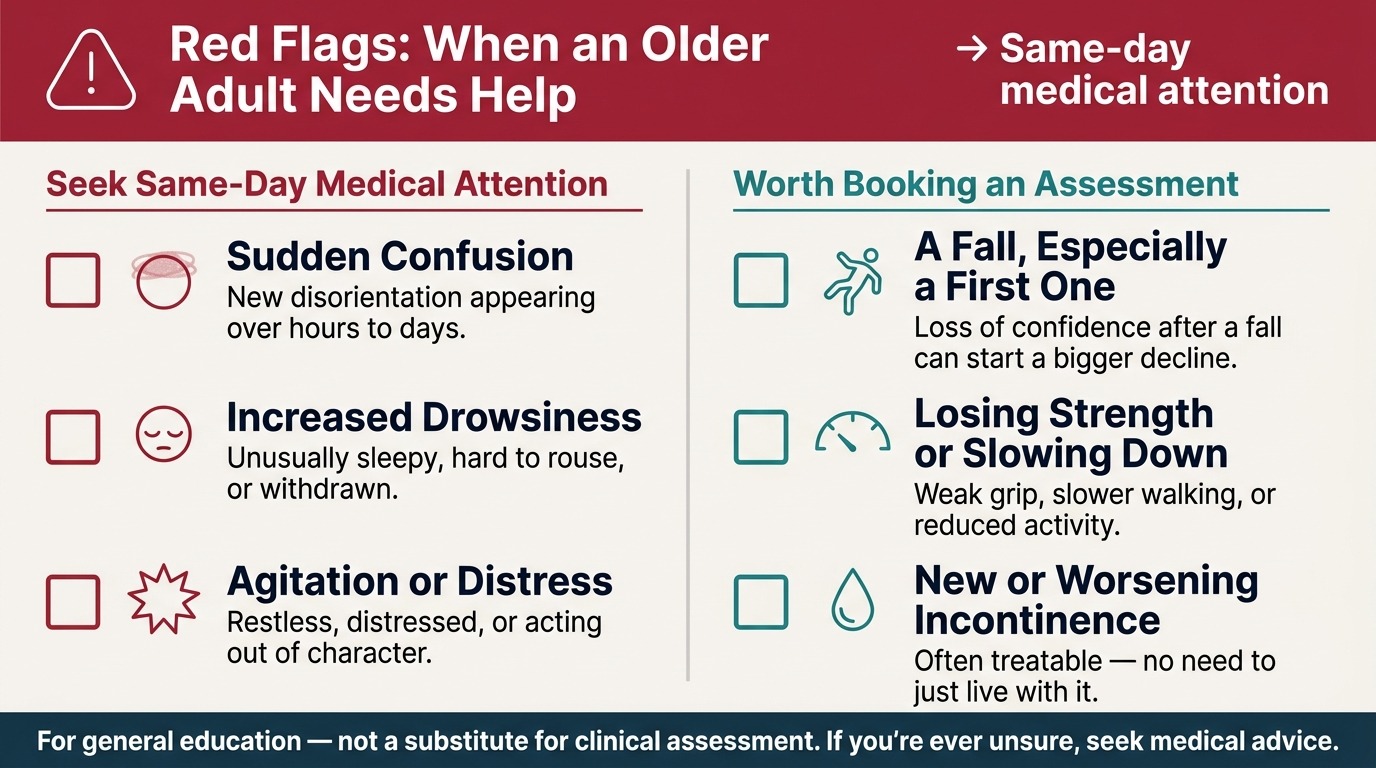
Much of what protects an older adult happens between appointments, at home, and it is usually family who make it happen. The measures below carry the most weight.
- Address the home environment first. Most falls in Singapore happen indoors. Grab bars in the bathroom, a non-slip mat, clear floor space free of loose wires and rugs, and adequate lighting along the route to the toilet at night quickly address a large share of the risk.
- Keep strength training going. Two to three sessions a week of resistance work for the legs, whether at home, at a community gym, or at an active aging center, does more for independence than walking alone. Walking is valuable but does not build the strength needed to rise from a chair or recover from a stumble.
- Review medications regularly. Sedatives, blood pressure medication, and anything that causes dizziness on standing all increase the risk of falls. A periodic review with a doctor or pharmacist, particularly after any hospital stay, is one of the highest value hours a family can arrange.
- Watch protein and overall intake. Reduced appetite is common with age and contributes directly to muscle loss. Unintentional weight loss over a few months is worth flagging to a doctor rather than accepting as normal.
- Do not let social withdrawal go unnoticed. Someone who stops going out after a fall loses fitness, confidence, and social contact, and that combination accelerates the decline more than any single factor.
- Treat sudden confusion as urgent. Acute changes in alertness or thinking over hours or days need same-day medical attention, not observation over the weekend.
Frequently Asked Questions About Geriatric Syndromes
What is the difference between a geriatric syndrome and normal ageing?
Normal ageing involves gradual changes such as slightly slower reactions or reduced stamina, without a real loss of independence. A geriatric syndrome interferes with daily functioning, often has multiple contributing causes, and typically develops over months rather than years. A clear decline in walking, memory, appetite or continence over a few months is worth having assessed rather than accepting as inevitable.
Can physiotherapy reduce the risk of falls in older adults?
Yes. Structured exercise programmes that combine progressive strength training with balance challenge have a strong evidence base for reducing falls in older adults living in the community. The effect comes from programmes that are supervised, progressed over time and sustained, rather than from a one-off set of exercises given on a handout.
How is frailty identified?
Clinicians look for a cluster of features rather than a single test result, typically unintentional weight loss, exhaustion, weak grip strength, slow walking speed and low activity levels. Physiotherapists commonly measure grip strength and gait speed as part of this. A formal diagnosis and any investigation of underlying causes sits with a doctor.
Is urinary incontinence in older adults treatable?
Often, yes. Pelvic floor muscle training is well supported for stress incontinence in particular, and is generally recommended before more invasive options are considered. The first step is establishing which type of incontinence is present, since stress and urge incontinence respond to different approaches.
How do I tell the difference between delirium and dementia?
Speed of onset is the clearest signal. Dementia develops gradually across months and years, while delirium comes on over hours or days and often fluctuates through the day. Sudden confusion in an older adult should be treated as a medical concern requiring prompt review, as a treatable condition, such as an infection or a medication change, often causes it.
How much does physiotherapy for an older adult cost in Singapore?
Sessions at PhysioVitae typically range from S$150 to S$280 depending on complexity and the physiotherapist you see. The first appointment is a full assessment including objective mobility and strength testing. We provide detailed receipts for insurance claims, and some integrated shield plans may require a specialist referral letter to be eligible.
Speak to Our Team
If you are unsure whether what you are seeing in a parent or in yourself needs assessment, that uncertainty is itself a reasonable reason to book one. An initial assessment is designed to establish where things actually stand and what can realistically be improved, not to commit anyone to a long program up front. You may find our patient education resources helpful for background reading, or you can look through our physiotherapy services to see what rehabilitation involves. If you would prefer to talk it through first, get in touch and we can point you in the right direction, including to another professional if that is who you need.