

This article is for educational purposes and does not replace a clinical assessment. If you are experiencing severe, sudden chest pain, call 995 or go to your nearest A&E immediately.
Left chest pain is one of the most common reasons people in Singapore seek urgent medical or physiotherapy care — yet many of the people who experience it are surprised to learn that the heart is not always the cause. At PhysioVitae, our clinical team regularly assesses patients who arrive worried about their heart, only to discover that their discomfort is rooted in a musculoskeletal, respiratory, or gastrointestinal issue that responds well to targeted physiotherapy and guided self-care.
Is left chest pain always a heart problem?
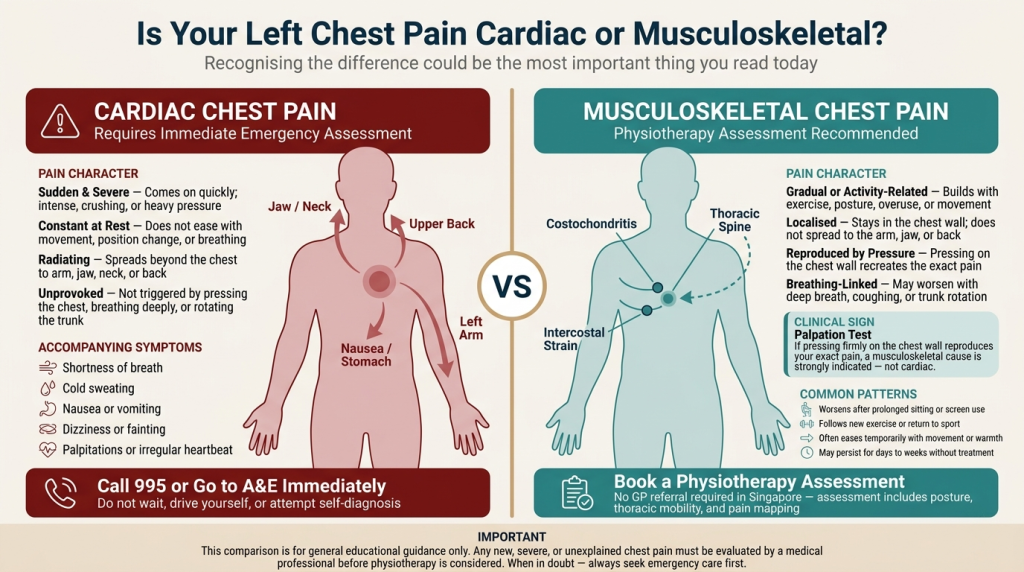
No! Left chest pain is not always cardiac in origin. While it is important to rule out heart-related causes first, a significant proportion of left-sided chest pain presentations are musculoskeletal, respiratory, or gastrointestinal in nature. Understanding the pattern, triggers, and accompanying symptoms of your pain is the first step toward identifying the right course of care.
That said, a medical professional should always evaluate any new, severe, or unexplained chest pain before attributing it to another cause. Our team at PhysioVitae works alongside your GP or specialist to ensure that physiotherapy is introduced at the right stage of your recovery.
Common causes of pain in the left side of the chest
Musculoskeletal causes
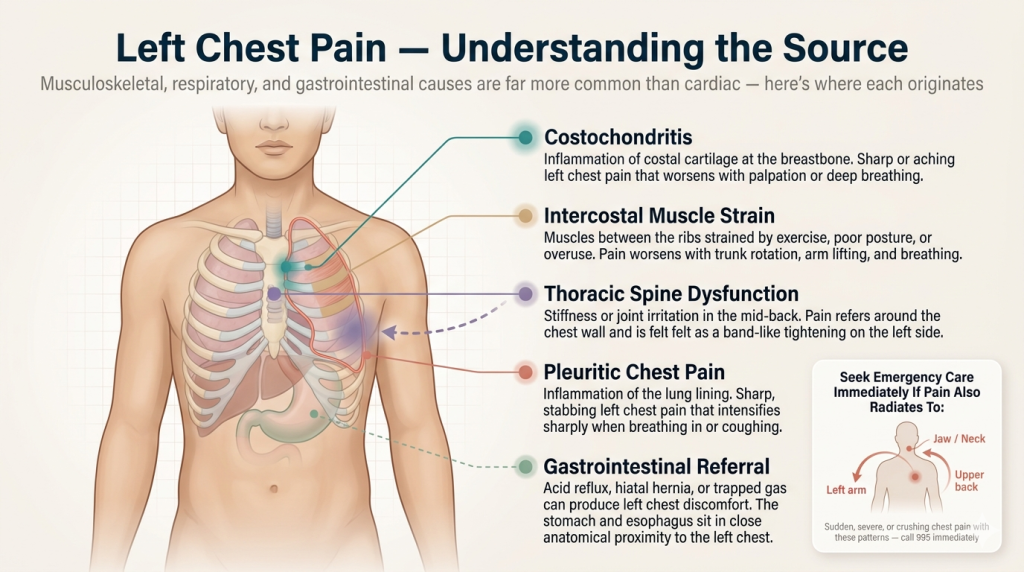
Musculoskeletal chest pain is far more common than most people expect. The chest wall is made up of ribs, costal cartilage, intercostal muscles, and the thoracic spine, and any of these structures can become a source of pain following injury, overuse, or postural strain.
- Costochondritis is one of the most common conditions seen in our clinic. It involves inflammation of the cartilage that connects the ribs to the breastbone, producing a sharp or aching pain on the left side of the chest that often worsens when pressing on the area or taking a deep breath. Many patients tell us their GP had already ruled out a cardiac cause before they came to us. And with good reason, because costochondritis pain can mimic the sensation of a heart problem closely enough to cause real anxiety.
- Intercostal muscle strain is another common culprit, particularly in patients who have recently started a new exercise programme, returned to sport after a break, or spent prolonged hours at a desk in poor posture. The intercostal muscles sit between the ribs and are engaged every time you breathe, rotate your trunk, or lift your arms, making them vulnerable to repetitive strain in both sedentary office workers and active individuals.
- Thoracic spine dysfunction is something our physiotherapists look for carefully during initial assessments. Stiffness or joint irritation in the mid-back can refer to pain around the chest wall, particularly toward the left side, in a pattern that patients often describe as tightening or a band-like sensation across the chest.
Clinical observation: In our experience treating patients across Singapore, desk-bound professionals between the ages of 30 and 55 are particularly prone to musculoskeletal chest pain driven by prolonged forward posture, shoulder rounding, and restricted thoracic mobility. If your pain tends to ease with movement and worsen after long periods of sitting, this category is worth exploring with a physiotherapist.
Read More: Types of Physiotherapy Services in Singapore
Respiratory causes (including pleuritic chest pain)
The lungs and their surrounding lining — the pleura — can also produce pain on the left side of the chest. Pleuritic chest pain refers specifically to pain that arises from inflammation of the pleura, and it is characterised by a sharp, stabbing quality that intensifies sharply with breathing in or coughing. If you have recently recovered from a respiratory infection, experienced a bout of pneumonia, or are managing a chronic lung condition, pleuritic pain is worth discussing with both your doctor and your physiotherapist.
Chest physiotherapy plays a meaningful supportive role for patients recovering from respiratory illness. Techniques including breathing retraining, airway clearance exercises, and progressive breathing work can help reduce residual discomfort, improve ventilation, and restore normal breathing patterns after infection or surgery. At PhysioVitae, our Breathe-Vitae and chest physiotherapy programmes are designed precisely for this kind of recovery.
Gastrointestinal causes
Not all left chest pain originates in the chest at all. The stomach and oesophagus sit in proximity to the left side of the chest, and conditions such as acid reflux (GERD), hiatal hernia, or even trapped gas can produce a burning or pressure-like sensation that patients frequently describe as chest pain. This type of pain often correlates with meals, lying down after eating, or leaning forward.
While physiotherapy does not directly treat gastrointestinal conditions, our team can help identify whether your chest pain is more likely musculoskeletal or referred, and refer you onward appropriately when a different clinical pathway is needed.
Chest pain when breathing or coughing, what does it mean?
Pain in the middle of the chest or left chest that is clearly triggered by breathing in or coughing is an important clinical signal. This pattern — sometimes called pain in the middle of the chest on inspiration — points strongly toward either a pleuritic or musculoskeletal cause rather than a cardiac one, since heart-related chest pain is typically not provoked by the mechanical act of breathing.
Common causes of chest pain when breathing or coughing include costochondritis, intercostal muscle strain, pleurisy, and post-surgical chest complications. In some cases, a cracked or bruised rib following an impact or a fall is the source — a diagnosis that clinical assessment and imaging can usually confirm quickly.
If your pain when breathing or coughing has persisted for more than a week, or if it is accompanied by fever, shortness of breath, or bloodstained sputum, please see a doctor promptly before commencing physiotherapy.
The Differences Between Right chest pain vs left chest pain
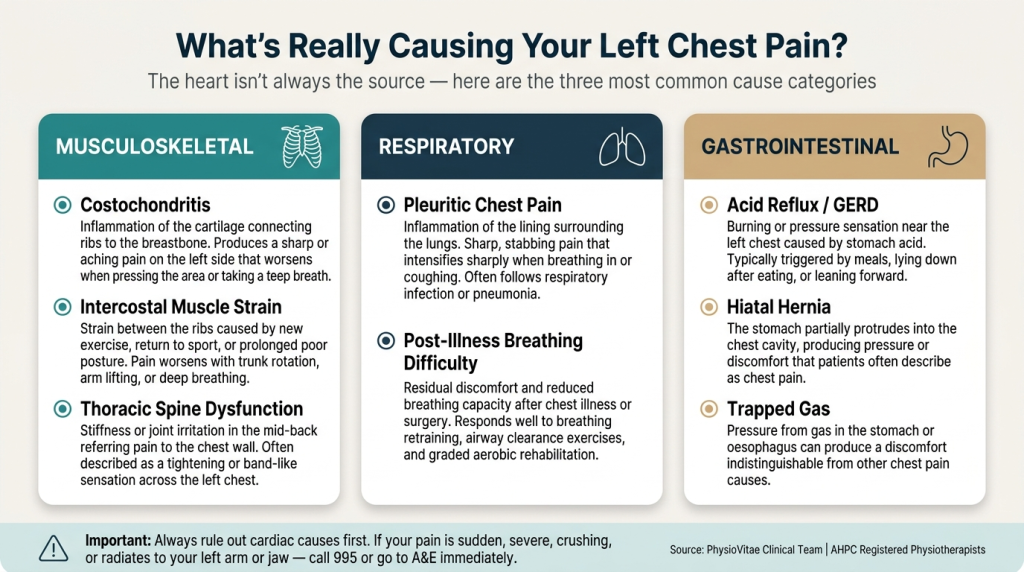
While both left and right chest pain can share similar musculoskeletal and respiratory causes, their anatomical contexts differ in meaningful ways.
Left-sided chest pain carries a higher index of suspicion for cardiac causes — particularly if it radiates to the left arm, jaw, or neck, or is accompanied by sweating, nausea, or a sense of impending doom. These are symptoms that should prompt an immediate call to 995 or a trip to A&E.
Right chest pain, by contrast, is less commonly cardiac and more often traced to liver, gallbladder, or right-sided lung and pleural issues. Musculoskeletal right chest pain follows largely the same pattern as left-sided pain.
For both presentations, a thorough physiotherapy assessment includes pain mapping, movement screening, and breathing evaluation to determine which structures are contributing to your symptoms.
How physiotherapy can help
At PhysioVitae, our approach to chest pain begins with a comprehensive assessment that covers your posture, thoracic mobility, breathing pattern, and the precise location and behaviour of your pain. We use movement screening and hands-on palpation to identify whether your symptoms are coming from the chest wall, the thoracic spine, or the breathing musculature — because the treatment for each is different.
For musculoskeletal chest pain, treatment may include:
- Manual therapy to the thoracic spine and rib joints to restore mobility and reduce referred pain
- Soft tissue work targeting intercostal muscles, the pectorals, and the thoracic erectors
- Postural correction and ergonomic guidance, particularly for desk-based patients
- Progressive strengthening exercises for the deep trunk and thoracic stabilisers
- Dry needling, where appropriate, to address muscular trigger points
For respiratory chest pain and post-illness recovery, our chest physiotherapy programme includes:
- Diaphragmatic and pursed-lip breathing retraining
- Airway clearance techniques to manage mucus and reduce the effort of coughing
- Graded aerobic exercise to rebuild breathing capacity and endurance
- Education on pacing and activity management during recovery
In our experience, Many of our patients who come in describing chest pain when coughing or breathing have been living with the discomfort for several weeks before seeking physiotherapy. In a number of these cases, a combination of thoracic joint mobilisation and structured breathing retraining has produced significant symptom improvement within three to five sessions — though individual timelines always vary based on the underlying cause and how long the condition has been present.
Sessions at PhysioVitae typically run for 45 to 60 minutes. Every treatment plan is personalised following your initial assessment, and all our physiotherapists are registered with the Allied Health Professionals Council (AHPC) of Singapore. You do not need a doctor’s referral to book a consultation. For pricing and insurance enquiries, please contact our clinic directly — we are happy to advise on what your policy may cover before your first visit.
When to go to A&E immediately
Please go to A&E or call 995 without delay if your left chest pain:
- Came on suddenly and is severe or crushing in quality
- Radiates to your left arm, jaw, neck, or back
- Is accompanied by shortness of breath, sweating, nausea, or dizziness
- Does not improve or worsen over a short period
- Occurs alongside palpitations, an irregular heartbeat, or fainting
- Follows a recent surgery, prolonged immobility, or a long-haul flight (which may suggest a blood clot)
Physiotherapy is appropriate for musculoskeletal and respiratory chest pain once serious cardiac or medical causes have been ruled out. Our team will always refer you onward if anything in your assessment raises a red flag.
Read More: Why Chest Pain Should Never Be Ignored
Frequently Asked Questions Left Chest Pain
- Can physiotherapy help with left chest pain?
Yes, in many cases. Physiotherapy is effective for musculoskeletal causes of left chest pain — including costochondritis, intercostal muscle strain, and thoracic spine dysfunction — as well as for respiratory causes such as post-illness breathing difficulties and pleuritic chest pain during recovery. A physiotherapy assessment can help identify whether your pain is suitable for physiotherapy management or requires further medical investigation first.
- Do I need a doctor’s referral to see a physiotherapist for chest pain in Singapore?
No. In Singapore, you can see a physiotherapist directly without a GP referral. However, for new or unexplained chest pain, we strongly recommend a medical evaluation to rule out cardiac or serious medical causes before commencing physiotherapy. If you have already seen your doctor and cardiac causes have been excluded, you are welcome to book directly with our team.
- How long does it take for chest physiotherapy to work?
For musculoskeletal chest pain, patients often notice meaningful improvement within three to six sessions, depending on the severity and duration of the condition. Respiratory rehabilitation programmes typically follow a structured eight to twelve-week pathway, with gradual improvements in breathing comfort, exercise capacity, and symptom control throughout. Your physiotherapist will give you a realistic timeline following your initial assessment.
- What is the difference between chest physiotherapy and regular physiotherapy?
Chest physiotherapy specifically targets the respiratory system — helping to clear mucus, retrain breathing patterns, and rehabilitate patients with lung conditions or post-surgical chest complications. Regular musculoskeletal physiotherapy focuses on the joints, muscles, and connective tissues of the chest wall and thoracic spine. At PhysioVitae, many patients with chest pain benefit from a combination of both approaches, and our team is trained across both disciplines.
- Is chest pain when breathing always serious?
Not always. Chest pain triggered by breathing is often musculoskeletal or pleuritic in origin and can respond well to physiotherapy. However, it should always be evaluated clinically — particularly if it is new, severe, or accompanied by other symptoms such as fever, breathlessness, or coughing up blood. When in doubt, see a doctor first.
- Can poor posture cause left chest pain?
Yes. Prolonged forward posture — common among desk workers and those who spend long hours on screens — can create stiffness in the thoracic spine and overload the chest wall muscles, both of which can refer pain to the left side of the chest. This is one of the most common patterns our team sees in Singapore’s working population, and it responds well to a combination of thoracic mobilisation, postural correction, and targeted strengthening.
Ready to find out what’s causing your chest pain?
If you have already had a medical assessment and cardiac causes have been excluded, physiotherapy may be the next step toward lasting relief. Our initial consultation includes a comprehensive assessment of your posture, thoracic mobility, breathing, and pain pattern — giving you a clear picture of what is driving your symptoms and what we can do about it.
You can read more about our chest physiotherapy services or explore our full range of patient education resources to learn more about the conditions we treat. When you are ready, contact us to book your assessment — no referral needed.