

What Is a Geriatric Chair? Who Needs One & How to Choose
A geriatric chair is a padded, supportive reclining chair designed to help older adults with limited mobility sit safely and comfortably for longer periods. Most models offer a high back, adjustable recline and sturdy armrests, and many come on wheels. The right type depends on your loved one’s posture, strength, skin health and daily care needs.
This article is for educational purposes and does not replace a clinical assessment.
What is a geriatric chair?
A geriatric chair, often shortened to “geri chair”, is a medical seating chair built for older adults who can no longer sit comfortably or safely in an ordinary armchair, sofa or dining chair. You will see them in hospital wards, community hospitals and nursing homes, and more and more families in Singapore now use them at home when a parent needs closer support during the day. If you are new to caring for an older parent, our article on geriatric care and who it is for is a helpful place to start.
From a clinical point of view, a well chosen geriatric chair does three jobs at once. It supports posture, holding the trunk and head in a position that makes breathing, eating and talking easier. It manages pressure, spreading body weight so that the skin over the tailbone and hips is not loaded for hours at a time. And it makes transfers safer, so that moving between bed, chair and toilet puts less strain on both the older person and the caregiver.
Wondering whether a geriatric chair is just another name for a wheelchair? Not quite. A wheelchair is designed for getting from one place to another, while a geriatric chair is designed for sitting well for long periods. Many geriatric chairs have castors so a caregiver can wheel them from the bedroom to the living room, but they are not meant for outdoor travel or for the person to propel themselves.
Who needs a geriatric chair?
A geriatric chair is usually considered when an ordinary chair is no longer keeping someone safe, comfortable or upright. The people who benefit most tend to fall into a few groups:
- Older adults with frailty or reduced trunk strength who slump, slide forward or lean to one side after a short time sitting.
- People living with advanced Parkinson’s disease, the effects of a stroke or other neurological conditions that affect sitting balance.
- Anyone who spends most of the day seated and is at higher risk of pressure injuries, especially if they are thin, have poor appetite or have continence problems.
- Older adults recovering after a hospital stay, a hip fracture or a serious illness who tire quickly and need regular rest in a supported position.
- People with heart or lung conditions who breathe more easily sitting semi reclined than lying flat.
- People with advanced dementia who need a comfortable, safe place to rest during the day.
- Families and helpers who are lifting or repositioning a loved one many times a day and need to reduce the physical strain.
One pattern we see often when we visit families at home is an elderly parent propped up with cushions in a sofa or dining chair that is far too deep or too low. Over a few weeks they slump further, eat less comfortably and find it harder to stand up. The problem is rarely a lack of effort on their part. The chair is simply working against their body. Slumping, falls and loss of strength also tend to travel together with other common geriatric syndromes, so seating is rarely the only thing worth looking at.
It is just as important to know when a geriatric chair is not the answer. If your loved one can still stand and walk with a little help, a chair that supports too much can quietly reduce how often they move. That is why our physiotherapists always ask one question first: will this chair support independence, or will it replace it?
Types of geriatric chairs
Geriatric chairs come in many designs, but most fall into three broad types. Each suits a different level of need.
High back riser recliners
A riser recliner looks much like a living room armchair, but a motor gently lifts and tilts the seat forward to help the person rise to standing. The high back supports the head and shoulders, and the recline function allows rest and leg elevation. These chairs suit older adults who can still stand and walk short distances but struggle to get up from a low or soft seat.
The riser function is helpful, but if it is used every single time, leg strength can decline further. We usually pair a riser recliner with simple sit to stand practice, so the chair assists the movement rather than doing all of it.
Tilt in space chairs
In a tilt in space chair, the whole seat tilts backwards as one unit while the angles at the hips and knees stay the same. This is different from a standard recline, where the backrest opens away from the seat. Reclining can cause a person with weak trunk muscles to slide forward and create friction on the skin, whereas tilting keeps their posture stable while shifting weight from the buttocks onto the back.
Tilt in space chairs suit people with very limited sitting balance, advanced neurological conditions or a high risk of pressure injuries. They are usually mounted on lockable castors and operated by a caregiver, and most can be fitted with lateral supports, head supports and pressure relieving cushions.
Shower and commode chairs
Shower and commode chairs are made with water resistant frames and a cut out seat, so they can be used over the toilet, as a standalone commode at the bedside, or in the shower. For someone who cannot stand safely on a wet floor, a shower chair is one of the simplest ways to reduce the risk of falls in the bathroom. Some models also offer tilt, which helps people who cannot hold themselves upright while being washed.
Before buying one, measure the bathroom door width, the space around the toilet and any step or kerb at the shower entrance. In many HDB flats these measurements decide which models will actually fit.
Key features to look for
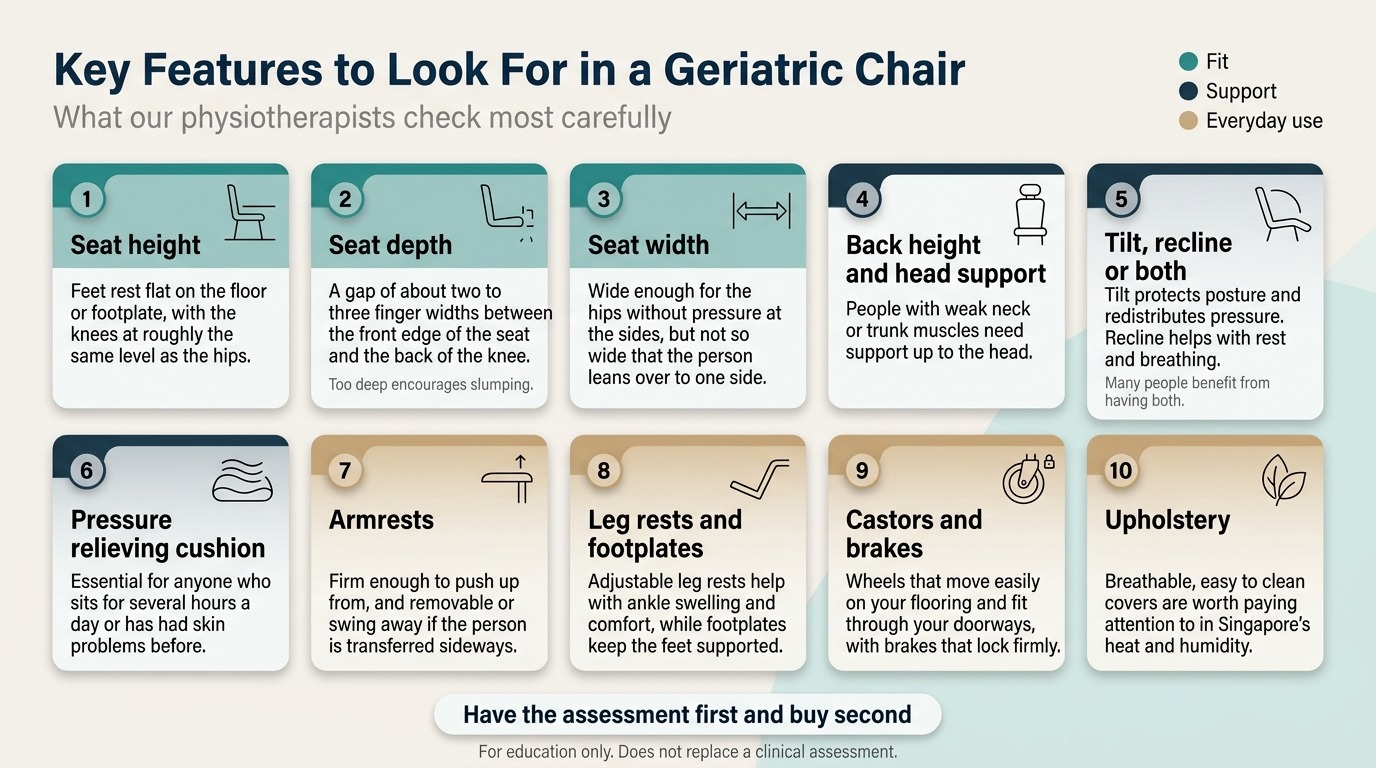
A geriatric chair that fits well makes a noticeable difference to comfort and safety. When you are comparing chairs, these are the features we check most carefully:
- Seat height. Feet should rest flat on the floor or footplate, with the knees at roughly the same level as the hips.
- Seat depth. There should be a gap of about two to three finger widths between the front edge of the seat and the back of the knee. A seat that is too deep encourages slumping.
- Seat width. Wide enough for the hips without pressure at the sides, but not so wide that the person leans over to one side.
- Back height and head support. People with weak neck or trunk muscles need support up to the head.
- Tilt, recline or both. Tilt protects posture and redistributes pressure; recline helps with rest and breathing. Many people benefit from having both.
- Pressure relieving cushion. Essential for anyone who sits for several hours a day or has had skin problems before.
- Armrests. Firm enough to push up from, and removable or swing away if the person is transferred sideways.
- Leg rests and footplates. Adjustable leg rests help with ankle swelling and comfort, while footplates keep the feet supported.
- Castors and brakes. Check that the wheels move easily on your flooring and fit through your doorways, and that the brakes lock firmly.
- Upholstery. Breathable, easy to clean covers are worth paying attention to in Singapore’s heat and humidity.
Geriatric chairs in Singapore: where to find them
In Singapore, geriatric chairs are sold and rented by medical equipment suppliers, and many will let you see or try a model before you commit. Renting can make sense for shorter term needs, such as the first few weeks after a hospital discharge, while buying is usually better value when the need is ongoing.
Families should also know about the Seniors’ Mobility and Enabling Fund (SMF), administered by the Agency for Integrated Care (AIC). Geriatric chairs and commodes are both on the SMF list of assistive devices. If approved, the fund covers up to 90% of the device cost or the maximum subsidy cap, whichever is lower, and the amount depends on a means test. Eligible applicants must live in the community rather than in a nursing home, and the device must be recommended after an assessment by a qualified assessor, such as a fully registered therapist. From 2026, eligibility was extended to permanent residents as well as Singapore citizens. AIC appoints a panel of suppliers for subsidised devices each year.
Scheme details change from time to time, so check the latest criteria with AIC directly by calling the AIC Hotline on 1800 650 6060 or visiting an AIC Link branch before you buy. Our practical advice is simple: have the assessment first and buy second. A chair chosen after a proper assessment is far less likely to end up unused in a corner.
How a physiotherapist can help you choose the right chair
Choosing a geriatric chair is really a clinical decision about posture, strength, skin and safety, which is why a physiotherapist is well placed to help. At PhysioVitae, a seating review is part of our geriatric care programme, and it can take place at our Orchard Road clinic or in your loved one’s own home.
What we assess. During the first session, which typically lasts 45 to 60 minutes, your physiotherapist will look at:
- How your loved one sits now: trunk control, head position and any tendency to slide or lean.
- Body measurements that determine seat height, depth and width.
- How they stand up, sit down and transfer, using validated measures such as the Timed Up and Go test and the Berg Balance Scale where appropriate.
- Skin and pressure risk, including how many hours a day they spend sitting.
- Breathing and comfort for those living with heart or lung conditions.
- The home itself: doorways, flooring, bathroom layout and the space available.
- Who provides care day to day, and what support family members or helpers need.
How we decide. We prioritise function before furniture. If a few weeks of strength and balance work could keep your parent rising from a standard chair, that is usually the better first step, because every time someone stands up on their own, they are practising a skill they need to stay independent. When a geriatric chair is the right choice, we recommend a type and set of features, explain why, and show family members and helpers how to adjust it and how to transfer safely. Once the chair arrives, we can review the fit and fine tune the setup.
What progress looks like. A better chair often brings quick wins in comfort, eating and alertness. Improvements in strength and transfers take longer and vary from person to person, so we set realistic goals together and track them with the same objective measures over time. Take one family we might see: a daughter caring for her father after a hip fracture, worried about how he will manage at home. A combination of the right chair, a short course of rehabilitation and coaching for his helper often makes daily life safer and calmer for everyone.
Who you will see. All our physiotherapists are registered with the Allied Health Professions Council (AHPC) of Singapore. Our principal physiotherapist Keith Chua specialises in geriatric rehabilitation and heart failure management, holds an MSc in Advanced Physiotherapy (Cardiorespiratory) and received the TTSH Clinical Educator Award in 2021. Our founding physiotherapists hold MSc degrees in Advanced Physiotherapy (Cardiopulmonary) with Distinction from University College London and are Certified Lifestyle Medicine Practitioners.
Practical details. No doctor’s referral is needed to see a physiotherapist in Singapore. Insurance coverage depends on your individual policy, so we recommend checking with your insurer, and our team can tell you which panels we currently support. For an overview of typical fees, read our guide to physiotherapy costs in Singapore. If you plan to apply for an SMF subsidy, let us know at the start and we will advise on the next steps.
Frequently asked questions
What is the difference between a geriatric chair and a wheelchair?
A wheelchair is designed for moving from place to place. A geriatric chair is designed for sitting safely and comfortably for long periods, with more support for the back, head and legs. Many geriatric chairs have castors for moving around the home, but they are not built for outdoor use.
Is there a subsidy for geriatric chairs in Singapore?
Yes. Geriatric chairs are covered under the Seniors’ Mobility and Enabling Fund (SMF), administered by AIC. Eligible seniors can receive up to 90% of the device cost or the subsidy cap, whichever is lower, after an assessment by a qualified assessor. Check the latest criteria with AIC before you buy.
Do I need a doctor’s referral to see a physiotherapist about seating?
No. In Singapore you can see a physiotherapist directly without a doctor’s referral. If your loved one has complex medical conditions or has recently left hospital, we will coordinate with their doctor so the plan is safe and appropriate.
Can a physiotherapist assess my parent’s seating at home?
Yes. Our home physiotherapy service is suited to older adults who find it difficult to travel. Assessing at home also lets us check doorways, flooring and bathroom space, and show family members or helpers how to use the chair safely.
Is it harmful to sit in a geriatric chair all day?
Long periods in any chair raise the risk of stiffness, muscle loss and pressure injuries. Regular position changes, short periods of standing or walking where possible, and a pressure relieving cushion all help. Your physiotherapist can suggest a routine that suits your loved one.
How long does a physiotherapy session last?
Sessions typically last 45 to 60 minutes, depending on the programme and individual needs. Your physiotherapist will recommend how many sessions are needed after the first assessment.
Finding the right next step
If you are not sure whether your loved one needs a geriatric chair, a better everyday chair or simply some focused strength work, a seating and mobility assessment is a good place to start. You can learn more about how we support older adults on our geriatric care page, see how our home physiotherapy service works for those who find travelling difficult, or contact our team to book an assessment. If you have a quick question first, WhatsApp us on +65 8017 1206 and we will be glad to help.
Written by the PhysioVitae Clinical Team. This article is for educational purposes and does not replace a clinical assessment. Subsidy details are based on information published by the Agency for Integrated Care and may change; please confirm eligibility with AIC.