

This article is for educational purposes and does not replace a clinical assessment. If you are experiencing sudden, severe chest pain or any symptoms that concern you, please seek emergency medical care immediately or call 995.
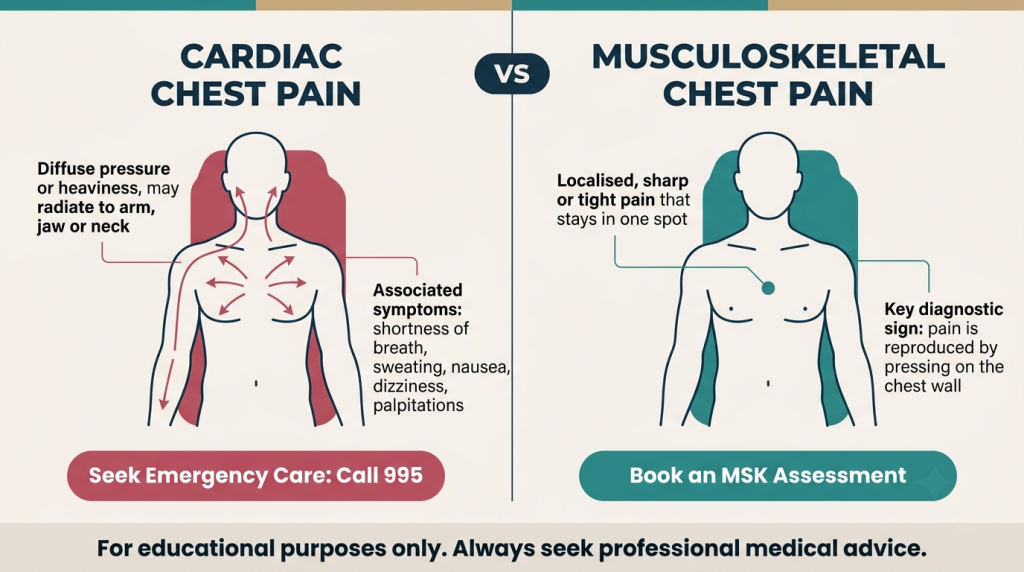
Musculoskeletal chest pain is chest discomfort that originates from the muscles, joints, cartilage, or bones of the chest wall and thoracic spine, and it accounts for a significant proportion of chest pain presentations in Singapore. At PhysioVitae, our clinical team assesses and treats MSK chest pain using targeted manual therapy, movement screening, and structured rehabilitation to address the root cause of your symptoms rather than masking them.
What Is Musculoskeletal Chest Pain?
Musculoskeletal chest pain refers to pain arising from the physical structures of the chest and upper back, including the ribs, costal cartilage, intercostal muscles, thoracic vertebrae, and the joints connecting them. It is distinct from cardiac chest pain, which originates from the heart and surrounding vessels, and from visceral pain, which arises from internal organs such as the lungs or digestive tract.
MSK chest pain is considerably more common than most people realise. Research in primary care settings consistently shows that a substantial proportion of patients presenting with chest pain are found to have a musculoskeletal cause rather than a cardiac one. This matters because the assessment pathway, the treatment approach, and the recovery outlook are fundamentally different depending on the source.
The challenge is that MSK chest pain can feel alarmingly similar to cardiac pain — particularly costochondritis and thoracic spine dysfunction, both of which can produce a tight, pressing, or burning sensation across the left side of the chest. This overlap in symptom quality is one of the reasons patients often arrive at a physiotherapy clinic only after cardiac causes have already been excluded by a GP or cardiologist.
Clinical note: Many of our patients presenting with MSK chest pain have already been through a cardiac workup before they reach us. Once serious causes are ruled out, physiotherapy is often the most direct route to recovery — and patients frequently see meaningful improvement within a small number of targeted sessions.
Common MSK Causes of Chest Pain
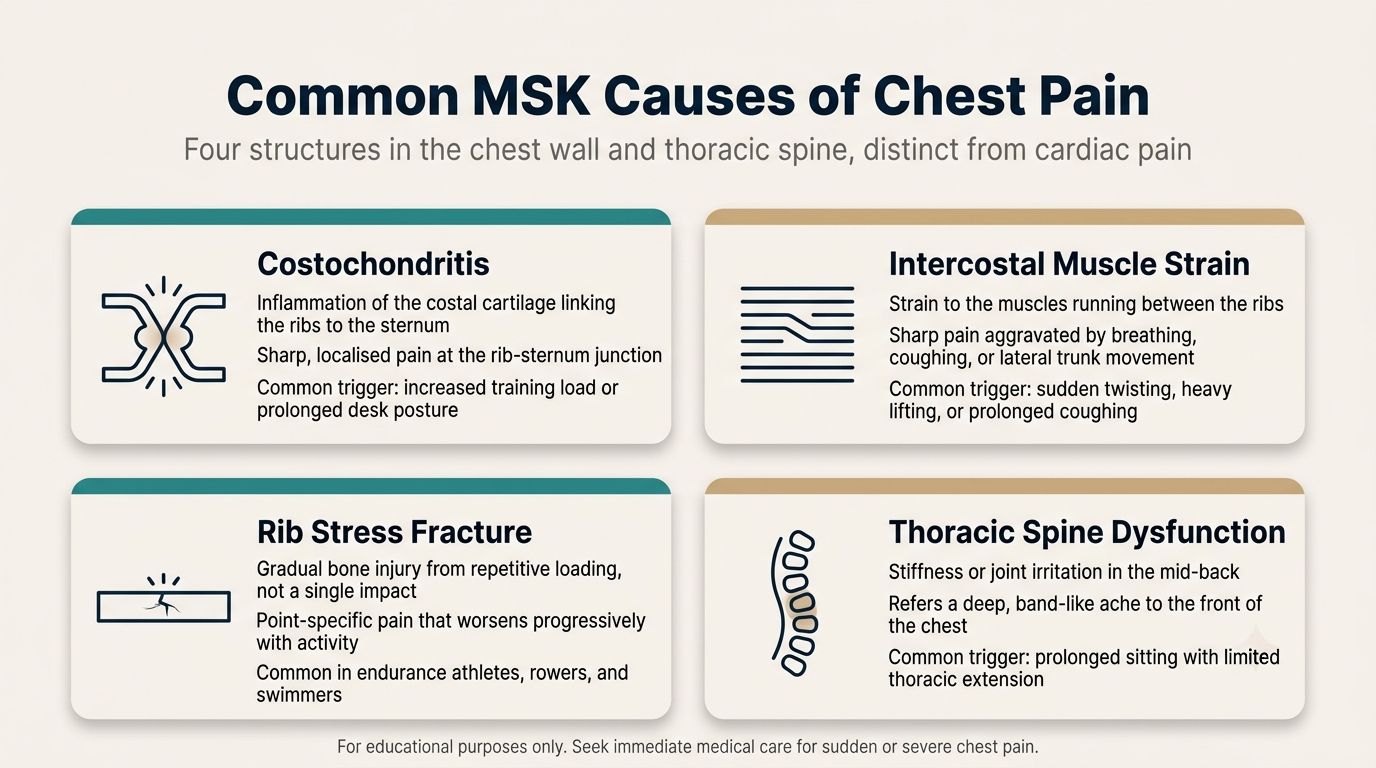
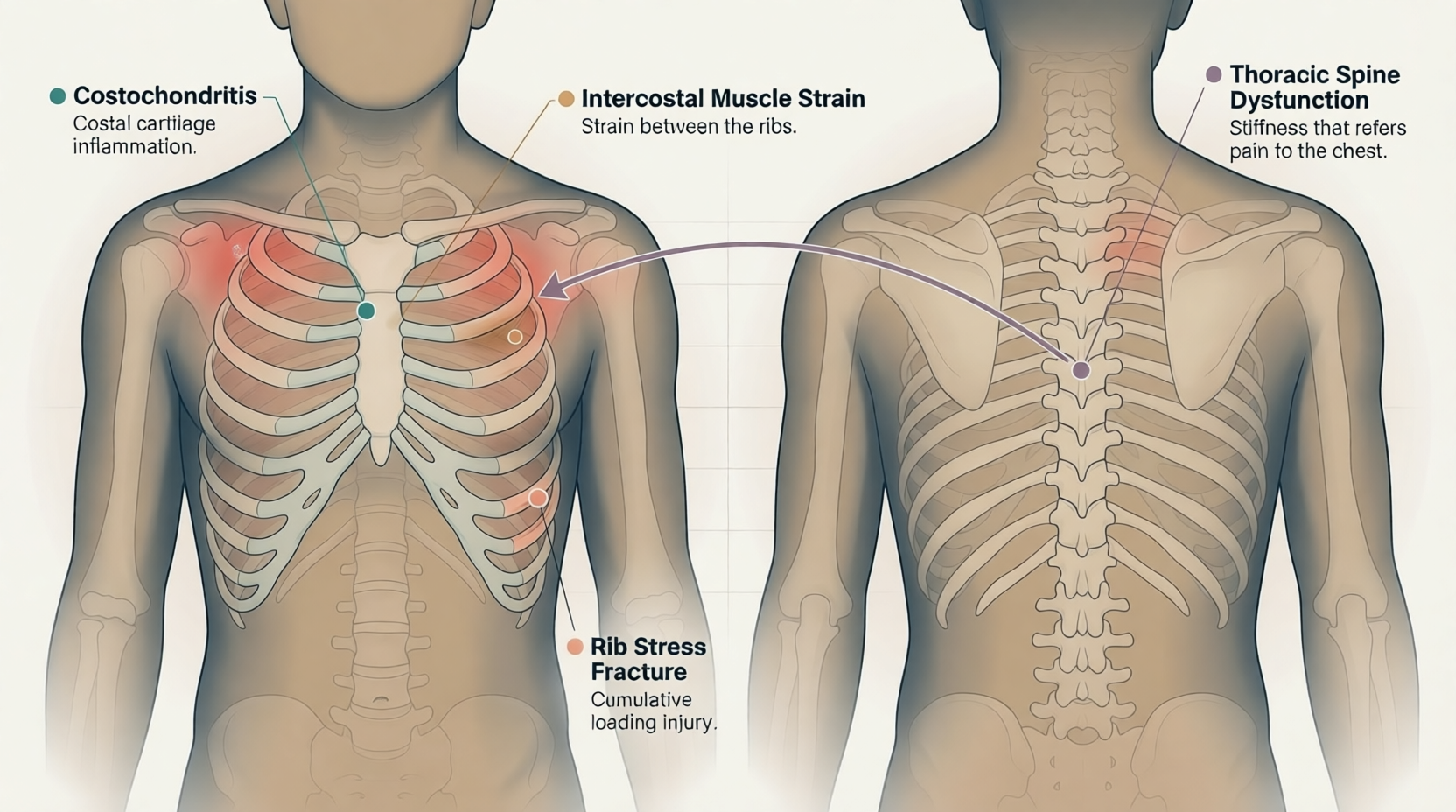
The chest wall and thoracic region contain multiple structures that can independently generate pain. Understanding which structure is involved is central to designing the right treatment plan. Here are the four most common MSK causes we see in clinical practice.
-
Costochondritis
Costochondritis is inflammation of the costal cartilage — the connective tissue that links the ribs to the sternum. It produces localised, reproducible tenderness over the front of the chest, typically at the junction between a rib and the breastbone. The pain often worsens with deep breathing, coughing, or pressing on the affected area, and it can persist for weeks or months if the underlying cause is not addressed.
Costochondritis is one of the conditions most commonly mistaken for a cardiac event, because the sensation — a tight, sharp pain on the left side of the chest — can be genuinely alarming. It is particularly prevalent among patients who have recently increased their training load, returned to exercise after a period of rest, or spent extended periods in a forward-flexed posture at a desk or workstation.
-
Intercostal Muscle Strain
The intercostal muscles run between adjacent ribs and are engaged every time you breathe, rotate your trunk, or reach overhead. A strain to these muscles typically follows a sudden twisting movement, a heavy lifting episode, prolonged coughing, or an uncontrolled sneeze, and it produces a sharp, localised pain that is clearly aggravated by breathing in, coughing, or lateral trunk movement.
In our clinical experience, intercostal strains are frequently under-assessed in Singapore’s office-working population. The repetitive microloading that comes from sustained poor posture — particularly the thoracic kyphosis that develops from long hours at a screen — creates chronic low-level tension in the intercostal muscles that can eventually tip into a symptomatic strain with relatively little provocation.
-
Rib Stress Fracture
Rib stress fractures are less common in the general population but occur with meaningful regularity among endurance athletes, rowers, swimmers, and individuals who carry heavy loads repetitively. They produce a localised, point-specific pain over the rib that worsens progressively with activity and is tender to direct palpation. Unlike a traumatic rib fracture, a stress fracture develops gradually through cumulative loading rather than a single impact event.
If a rib stress fracture is suspected, imaging confirmation is required before physiotherapy management begins. Once the fracture is confirmed and the acute phase has passed, a graduated return-to-activity programme is central to safe recovery.
-
Thoracic Spine Dysfunction
The thoracic spine is one of the most clinically underappreciated sources of chest pain. Stiffness, joint irritation, or facet joint dysfunction in the mid-back can refer pain anteriorly around the chest wall — producing a deep ache, tightness, or band-like sensation that patients frequently describe as coming from the chest rather than the back. This pattern is especially common in patients who spend long hours seated with limited thoracic extension.
Thoracic dysfunction is also a frequent contributor to costochondritis and intercostal muscle strain, because a stiff thoracic spine places greater load on the anterior chest wall structures. Treating the thoracic spine alongside the chest wall is often essential for a lasting outcome — addressing only the symptomatic area without restoring thoracic mobility is a common reason for recurring chest wall pain.
How to Tell If Your Chest Pain Is Musculoskeletal
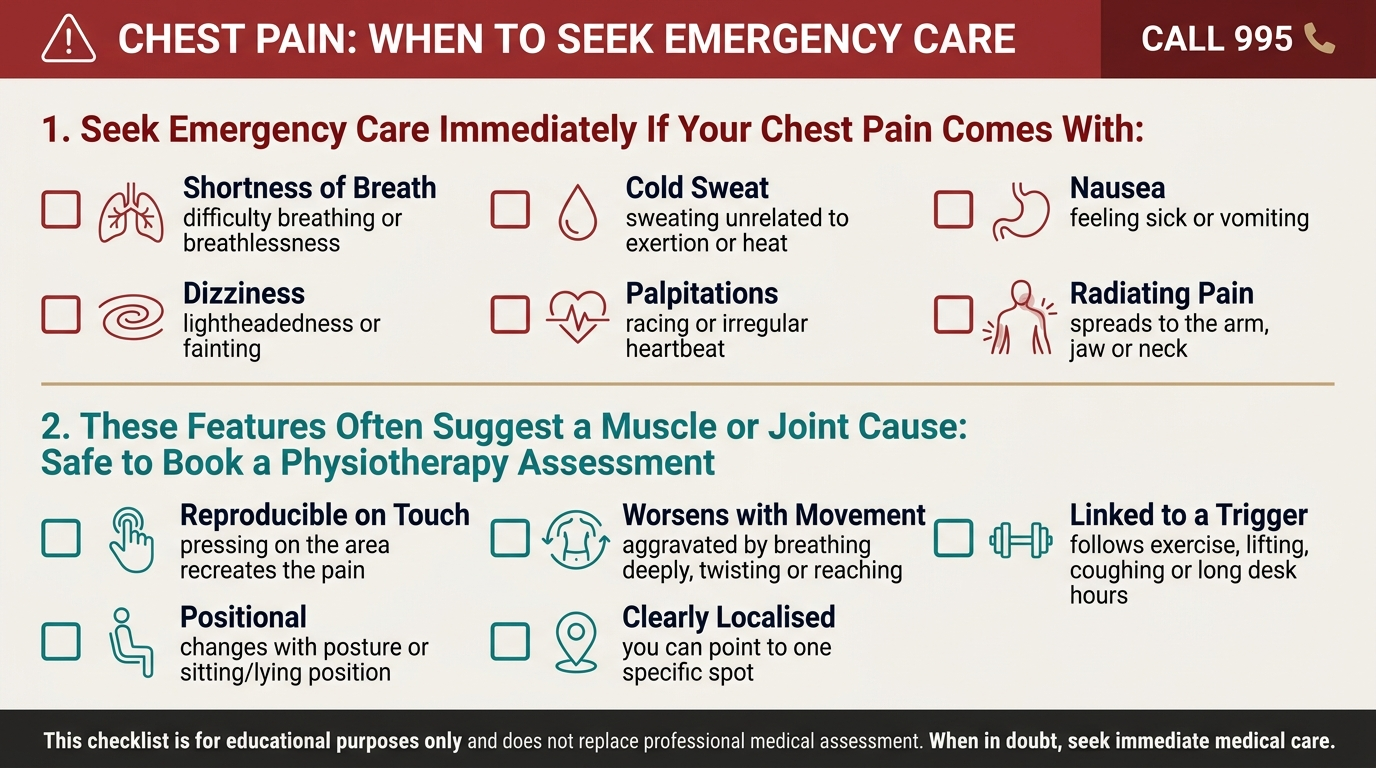
No symptom pattern alone can definitively confirm that chest pain is musculoskeletal rather than cardiac or visceral. A medical professional should evaluate any new, unexplained, or severe chest pain before physiotherapy begins. That said, certain features are strongly associated with an MSK source:
- The pain is reproducible — pressing on the chest wall, ribs, or thoracic spine reliably recreates or changes your symptoms
- The pain is clearly aggravated by movement — breathing in deeply, twisting, coughing, or reaching overhead makes it worse
- The pain is positional — it worsens in certain sitting or lying positions and eases with movement or a change in posture
- The pain is localised — you can point to a specific spot rather than a diffuse or radiating sensation
- The pain followed a physical trigger — a gym session, a heavy lift, a bout of coughing, a period of increased desk time, or a postural change
- The pain is not accompanied by shortness of breath, sweating, nausea, dizziness, palpitations, or radiation to the arm, jaw, or neck
If your pain has already been evaluated and cardiac or serious medical causes have been excluded, these features provide a reasonable basis for pursuing a physiotherapy assessment to identify which MSK structure is involved and what the most appropriate treatment is.
Diagnosis and Assessment Process
At PhysioVitae, our MSK chest pain assessment follows a structured process designed to identify the specific source and contributing factors before any treatment begins. We do not apply a generic treatment protocol to chest pain, because the right intervention for costochondritis is meaningfully different from the right intervention for thoracic facet dysfunction or an intercostal strain.
Your initial assessment will typically include:
- Detailed clinical history — onset, behaviour, aggravating and easing factors, prior medical evaluations, and relevant lifestyle context, including your work setup, physical activity, and postural habits
- Pain mapping and palpation — systematic assessment of the chest wall, costal cartilage, intercostal spaces, and thoracic spine to identify reproducible tenderness and pinpoint the structural source
- Movement screening — assessment of thoracic rotation, extension, and lateral flexion to evaluate joint mobility and identify movement restrictions contributing to your symptoms
- Breathing pattern assessment — evaluation of your resting breathing mechanics and whether altered breathing patterns are loading the chest wall structures
- Functional testing — specific movement tests that clarify whether your symptoms are arising from the anterior chest wall, the thoracic joints, or referred from elsewhere in the musculoskeletal system
All PhysioVitae physiotherapists are registered with the Allied Health Professionals Council (AHPC) of Singapore. Our team has expertise across musculoskeletal, cardiopulmonary, and sports rehabilitation disciplines, which is particularly relevant for chest pain presentations, where the clinical picture often involves structures from more than one system.
Physiotherapy Treatment Options
Treatment for MSK chest pain at PhysioVitae is tailored to the specific diagnosis identified in your assessment. Depending on the structures involved, your programme may include a combination of the following:
- Manual therapy to the thoracic spine and rib joints restores restricted joint mobility, reduces mechanical loading on the chest wall, and often produces immediate improvement in pain quality and range of movement. For patients with costochondritis or thoracic dysfunction, this is frequently the single most impactful early intervention.
- Soft tissue therapy targeting the intercostal muscles, pectoral musculature, and thoracic erectors reduces muscular tension that is maintaining or amplifying your chest wall symptoms. This is often combined with dry needling for patients with established trigger points in these regions.
- Breathing retraining is a component of treatment that tends to be underutilised in MSK chest pain but carries significant clinical value. Altered breathing mechanics — common in both desk workers and endurance athletes — can place chronic overload on the anterior chest wall. Diaphragmatic retraining and rib expansion exercises address this loading pattern directly.
- Postural correction and ergonomic guidance are essential for patients whose MSK chest pain is driven or maintained by sustained desk posture. Thoracic extension mobility work, scapular stabilisation exercises, and workstation adjustments form a core part of the programme for this patient group.
- Progressive loading and exercise prescription rebuilds resilience in the chest wall structures and thoracic spine. The specific exercises prescribed depend on your diagnosis, fitness level, and activity goals — a programme for a returning runner looks different from one for a post-surgical patient or a sedentary office worker.
Expertise signal: We prioritise thoracic spine assessment and treatment before focusing solely on the anterior chest wall, because in our clinical experience, unaddressed thoracic stiffness is one of the most consistent drivers of recurring MSK chest pain. Treating the chest wall in isolation — without restoring thoracic mobility — frequently leads to short-term relief followed by relapse.
Recovery Timeline
Recovery timelines for MSK chest pain vary depending on the diagnosis, the duration of symptoms before treatment began, and how consistently the patient engages with their home exercise programme. As a general guide:
- Acute intercostal muscle strain: most patients notice meaningful improvement within two to four sessions, with full recovery typically achieved within three to six weeks
- Costochondritis: a more variable timeline — mild to moderate cases often improve over four to eight sessions, while chronic or repeatedly aggravated presentations can require longer programmes with more gradual loading
- Thoracic spine dysfunction: joint mobility typically responds well to manual therapy within the first two to three sessions, with lasting improvement dependent on the patient maintaining thoracic mobility through prescribed exercise
- Rib stress fracture: recovery is guided by the stage of healing confirmed on imaging, with physiotherapy-directed return-to-activity programmes typically spanning six to twelve weeks
Sessions at PhysioVitae run for 45 to 60 minutes, and your physiotherapist will provide a realistic session estimate at your initial assessment. No referral is needed to book, and all sessions include a hands-on treatment component and a personalised home exercise programme.
Frequently Asked Questions About Musculoskeletal Chest Pain
- Can physiotherapy treat musculoskeletal chest pain?
Yes. Physiotherapy is one of the most effective treatments for MSK chest pain, addressing the specific structural source — whether that is the costal cartilage, intercostal muscles, thoracic joints, or a combination — through manual therapy, exercise prescription, and postural correction. Most patients with confirmed MSK chest pain see meaningful improvement within three to six sessions, though timelines vary based on the diagnosis and duration of symptoms.
- How do I know if my chest pain is from my muscles or my heart?
No symptom description alone can definitively distinguish MSK from cardiac chest pain, and any new or unexplained chest pain should be medically evaluated before assuming a musculoskeletal cause. That said, MSK chest pain tends to be reproducible on palpation, clearly aggravated by movement or breathing, localised to a specific spot, and associated with a physical trigger such as exercise, lifting, or sustained posture. Cardiac chest pain more commonly presents as a diffuse pressure or heaviness that may radiate to the arm, jaw, or neck, and is not reproduced by pressing on the chest wall.
- Do I need a doctor’s referral to see a physiotherapist for chest pain?
No. In Singapore, you can see a physiotherapist directly without a GP referral. However, for new or unexplained chest pain, we strongly recommend a medical evaluation to rule out cardiac and other serious causes before beginning physiotherapy. Once those causes have been excluded, you are welcome to book directly with our team — no referral paperwork required.
- What happens in the first physiotherapy session for MSK chest pain?
Your first session at PhysioVitae follows a structured five-step process: clinical history, comprehensive assessment, targeted intervention, and the beginning of your treatment plan. In the initial consultation, your physiotherapist will conduct a thorough pain mapping and movement assessment to identify the structural source of your symptoms, and will typically begin hands-on treatment in the same session where appropriate. You will leave with a clear explanation of the diagnosis, a realistic timeline, and a home exercise programme to begin straight away.
- Can poor posture really cause chest pain?
Yes — and this is one of the most common patterns our team sees among Singapore’s office-working population. Prolonged forward posture reduces thoracic extension, loads the anterior chest wall structures, and creates chronic tension in the intercostal muscles and costal cartilage. Over time, this can produce costochondritis, intercostal strain, or thoracic dysfunction that presents as chest pain. Postural correction, thoracic mobility work, and ergonomic guidance are central components of treatment for this patient group.
- Is MSK chest pain serious?
MSK chest pain is not life-threatening and does not carry the same urgency as cardiac chest pain. However, it can significantly affect quality of life, limit physical activity, and become chronic if the underlying structural cause is not addressed. Seeking physiotherapy assessment promptly — once cardiac and serious medical causes have been excluded — is the most effective way to prevent short-term MSK chest pain from becoming a long-term problem.
Book an MSK Assessment
If your chest pain has already been medically evaluated and cardiac causes have been excluded, a physiotherapy assessment at PhysioVitae is the logical next step. Our initial consultation includes a comprehensive structural assessment of your chest wall and thoracic spine, a clear explanation of what is driving your symptoms, and, where appropriate, hands-on treatment in the same session.
Sessions run for 45 to 60 minutes. No referral is needed. You can call us on +65 8017 1206, message us through the website, or use our online booking form.
To learn more about how we approach MSK conditions, explore our full physiotherapy and rehabilitation services, browse our patient education library for condition-specific information, or visit our frequently asked questions for an overview of what to expect before your first visit. When you are ready, contact us to book your MSK chest assessment — no referral needed.