
Chest pain is one of the most anxiety-provoking symptoms a person can experience, and rightly so. While a cardiac cause must always be ruled out first, the majority of chest pain presentations seen in primary care and physiotherapy settings are non-cardiac in origin, arising instead from the muscles, joints, ribs, lungs, or digestive system. Understanding what is driving your chest pain is the first step to getting the right care, and at PhysioVitae, a Singapore-based physiotherapy clinic, that begins with a thorough clinical assessment.
Chest pain has many possible causes: cardiac, musculoskeletal, respiratory, gastrointestinal, and psychological. Cardiac chest pain requires immediate emergency care. Non-cardiac chest pain, including musculoskeletal and pleuritic causes, can often be effectively managed with physiotherapy once a cardiac cause has been excluded.
Why Chest Pain Should Never Be Ignored
Chest pain is a symptom, not a diagnosis, and the range of conditions that can produce it spans from the benign to the immediately life-threatening. This is why the first clinical priority, always, is to exclude a cardiac cause before attributing symptoms to a musculoskeletal or other non-cardiac source.
Even experienced clinicians approach chest pain cautiously. A presentation that feels like a muscle strain may, in some cases, turn out to be cardiac in origin. Conversely, what feels alarming may ultimately prove to be costochondritis or a thoracic disc problem. The distinction matters, which is why proper assessment by a qualified clinician is non-negotiable.
If you have any doubt about whether your chest pain is cardiac in nature, do not delay. Call emergency services (995 in Singapore) or present to your nearest emergency department immediately.
Cardiac vs Non-Cardiac Chest Pain: What’s the Difference?
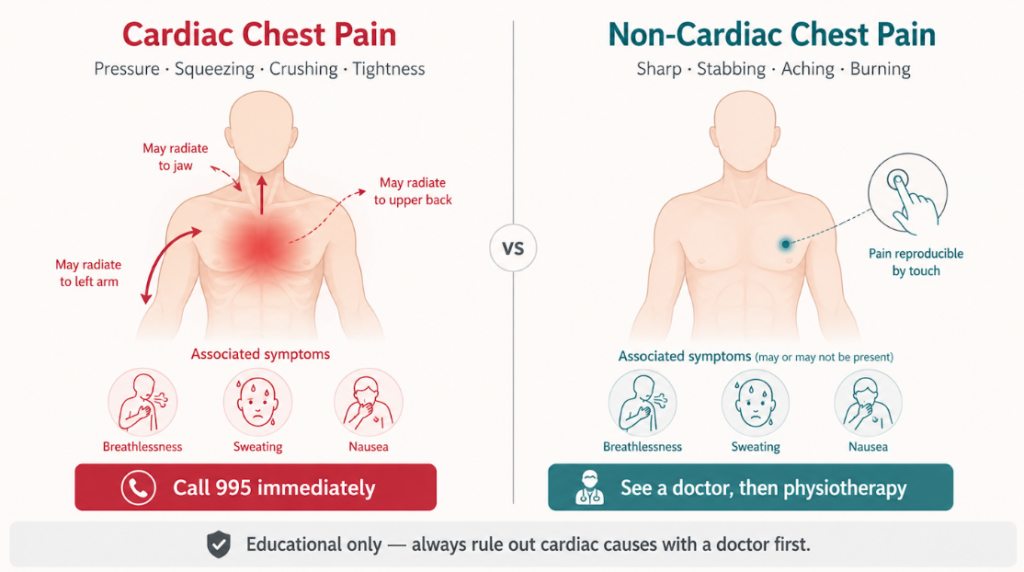
The table below provides a general guide to differentiating cardiac from non-cardiac chest pain. It is intended for educational purposes only; it is not a diagnostic tool, and no symptom profile should be used to self-exclude a cardiac cause without clinical assessment.
| Feature | Cardiac Chest Pain | Non-Cardiac Chest Pain |
| Quality | Pressure, squeezing, tightness, crushing | Sharp, stabbing, aching, burning |
| Location | Central chest; may radiate to the arm, jaw, or back | Often localised; can be reproduced by touch |
| Action | Seek emergency care immediately | See a clinician; rule out cardiac cause first |
A key clinical feature of musculoskeletal chest pain, and one that is particularly useful diagnostically, is reproducibility. If a physiotherapist or clinician can reproduce your chest pain by pressing on a specific area of the chest wall, or by placing the thoracic spine in a particular position, this strongly suggests a musculoskeletal source. Cardiac pain is not reproduced this way.
Musculoskeletal Chest Pain
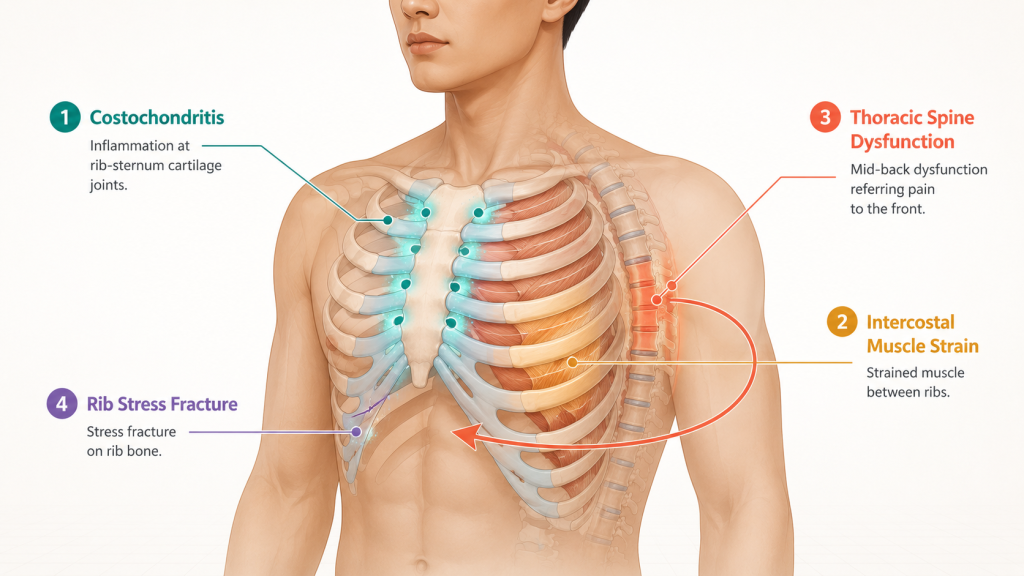
Musculoskeletal chest pain is the most common non-cardiac cause encountered in physiotherapy practice. It includes:
- Costochondritis, inflammation of the cartilage connecting the ribs to the sternum. Pain is typically sharp, localised, and worsens when pressing directly on the affected area.
- Intercostal muscle strain often follows a bout of coughing, heavy lifting, or a direct impact. Pain worsens with trunk rotation and deep breathing.
- Thoracic spine dysfunction, referred pain from the mid-back joints or discs, can present as anterior chest pain. This is commonly seen in desk workers and is frequently misattributed to a cardiac cause.
- Rib stress fractures, in athletes or those with osteoporosis, can cause sharp, localised pain aggravated by breathing or movement.
In our clinical experience, thoracic spine–referred chest pain is significantly under-recognised. Many patients who present to PhysioVitae with anterior chest pain that has already been cardiac-cleared turn out to have a thoracic joint restriction or disc-related problem as the primary driver. A thorough thoracic spine assessment often reveals the cause immediately.
Assessment of musculoskeletal chest pain at PhysioVitae begins with a detailed history and a systematic physical examination covering the thoracic spine, ribs, sternocostal joints, and intercostal muscles. We use palpation, active and passive range of motion testing, and thoracic movement screening to identify the anatomical source before selecting treatment modalities. You can read more about the conditions we manage and our treatment approach on our physiotherapy and rehabilitation services page.
Read More: Physiotherapy in Singapore: What to Expect, Services & How to Choose a Clinic
Red Flag Symptoms: Call Emergency Services Immediately
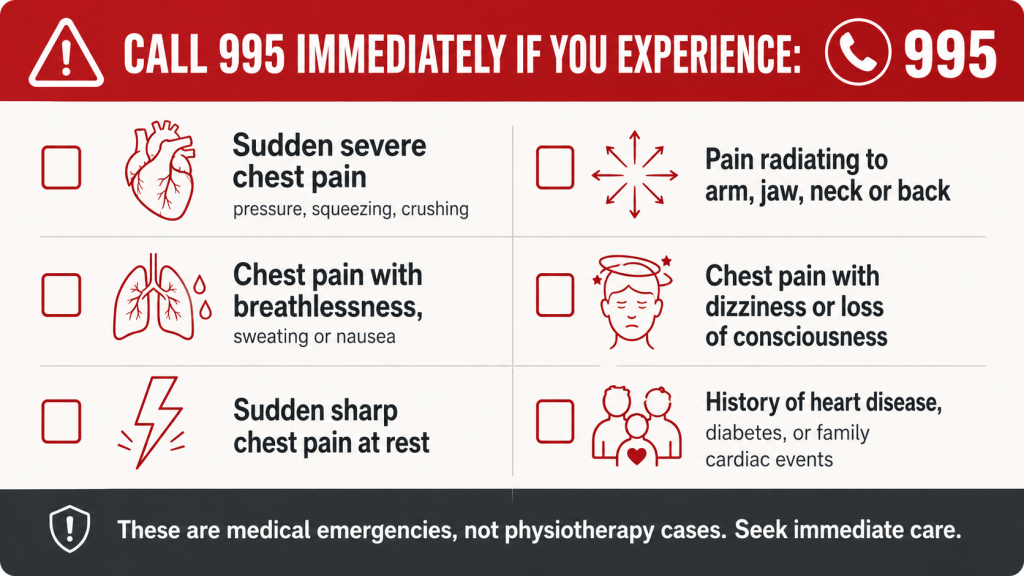
⚠ If you experience any of the following, call 995 (Singapore Emergency) immediately or go to your nearest A&E. Do not wait, and do not drive yourself.
- Sudden, severe chest pain, especially pressure, squeezing, or crushing in quality
- Chest pain radiating to the left arm, jaw, neck, or back
- Chest pain accompanied by breathlessness, sweating, nausea, or vomiting
- Chest pain with light-headedness, dizziness, or loss of consciousness
- Sudden onset of sharp chest pain with breathlessness at rest (possible pulmonary embolism or pneumothorax)
- Chest pain in a patient with known heart disease, diabetes, or a family history of cardiac events
These are not situations for physiotherapy. They are medical emergencies. Once a cardiac or other serious cause has been excluded by a doctor, physiotherapy assessment and management of non-cardiac chest pain can begin.
Read More: How Physiotherapy Helps You Achieve a Healthier Quality of Life
How Physiotherapy Can Help Non-Cardiac Chest Pain
Once cardiac and other serious causes have been excluded, physiotherapy is one of the most effective pathways for managing non-cardiac chest pain, particularly where the cause is musculoskeletal, respiratory, or postural. You can read about our clinical approach to chest pain assessment and recovery to understand how we work.
A physiotherapy assessment for chest pain at PhysioVitae will typically include:
- Thorough history, onset, nature, location, aggravating and relieving factors, and any associated symptoms
- Thoracic spine and chest wall examination, palpation of the costochondral joints, intercostal spaces, and thoracic facet joints
- Movement screening, thoracic rotation, extension, lateral flexion, and ribcage expansion assessment
- Breathing pattern assessment, identifying any dysfunctional breathing mechanics contributing to symptoms
- Functional and postural analysis, particularly relevant for desk workers and those with sustained loading patterns
All physiotherapists at PhysioVitae are registered with the Allied Health Professionals Council (AHPC) of Singapore. You can meet our team of AHPC-registered physiotherapists and read their clinical backgrounds. Sessions are 45 to 60 minutes, and your first appointment includes a comprehensive assessment so we understand the full clinical picture before beginning treatment. No referral is needed; you can book directly.
Frequently Asked Questions About Chest Pain
When should I call emergency services for chest pain?
Call 995 immediately if your chest pain is sudden and severe, particularly if it feels like pressure, squeezing or crushing. The same applies if the pain spreads to your left arm, jaw, neck or back, or if it comes with breathlessness, sweating, nausea or dizziness. Do not wait to see if it passes. Do not drive yourself to hospital. These are medical emergencies and need to be treated as such.
How do I know if my chest pain is cardiac or musculoskeletal?
Cardiac chest pain tends to feel like pressure, tightness or crushing in the centre of the chest and may spread to the arm, jaw or back. Musculoskeletal chest pain is usually sharper and more localised. One of the most useful clinical tests is reproducibility: if a physiotherapist can recreate your pain by pressing on the chest wall or moving your thoracic spine, that points strongly to a musculoskeletal source rather than a cardiac one. That said, symptoms alone are never enough to rule out the heart. A proper clinical assessment always comes first.
What are the most common musculoskeletal causes of chest pain?
In physiotherapy practice we see four main causes: costochondritis, which is inflammation of the cartilage connecting the ribs to the sternum; intercostal muscle strain, commonly brought on by heavy coughing or lifting; thoracic spine dysfunction, where stiffness or disc problems in the mid back refer pain to the front of the chest; and rib stress fractures, seen mostly in athletes or patients with osteoporosis. Thoracic spine referral is probably the most under-recognised of the four and turns up regularly in desk workers.
Can a back problem cause pain at the front of the chest?
Yes, and it happens more often than people expect. Stiffness or disc problems in the thoracic spine can refer pain forward to the chest wall, and patients are sometimes told their chest pain has no clear cause when the actual source is in their back. It is especially common in people who sit for long periods. A thorough assessment of the thoracic spine will often identify this straight away.
When is it safe to see a physiotherapist for chest pain?
Once a doctor has cleared you of a cardiac or other serious cause, physiotherapy is a sensible next step. A good number of patients come to us after an A&E visit or cardiology review where nothing cardiac was found. You do not need a formal referral to book an assessment at PhysioVitae.
What does a physiotherapy assessment for chest pain involve?
We start with a full clinical history covering when the pain started, what it feels like, what makes it better or worse and any associated symptoms. From there we examine the thoracic spine and chest wall, check movement in all directions, assess your breathing pattern, and look at posture and loading habits. The first session is 45 to 60 minutes. All our physiotherapists are registered with the Allied Health Professionals Council (AHPC) of Singapore. To book, call us on +65 8017 1206.
Book a Chest Pain Assessment at PhysioVitae
If you have received medical clearance and are looking for expert physiotherapy assessment and management of musculoskeletal or respiratory chest pain, the PhysioVitae team can help. Our approach starts with a thorough assessment, because understanding what is driving your pain is what makes treatment effective.
To explore the full range of conditions we treat, including cardiopulmonary rehabilitation, thoracic spine conditions, and musculoskeletal pain, visit our physiotherapy and rehabilitation services page. For ongoing reading on chest pain, posture, and recovery, browse the PhysioVitae physiotherapy blog, or visit our patient education library, including our companion article on what musculoskeletal chest pain is and how it differs from other causes.
When you are ready to book an assessment, contact our clinical team or call +65 8017 1206. We are at 360 Orchard Road, #12-06 International Building, Singapore 238869. Monday to Friday, 9 am–6 pm; Saturday, 9 am–1 pm.